
How do I evaluate current team capabilities and gaps?
In the ever-evolving world of corporate business, checking if your team is prepared for the job at hand is crucial. This check comes in many ways, but ultimately it falls to the leader of the team to make sure the people and processes are exactly where they need to be: PREPARED. To achieve this result, we use what we call the audit – a simple process of reviewing any activity or task against a specific checklist.
As a first-time manager, your job is to make sure from the very beginning that your team is prepared from multiple points of view. This will not be an easy task, as you might have a new team that is just starting out, a team that functioned with a “let’s let things happen as they do” mindset, or a team that excels in some aspects but lacks in others.
Today, I will help you with an in-depth overview of a proper team audit – one based on the ISO 9001:2015 standard, which is the best reference to use.
What do I need, as a first-time manager, to complete a team audit?
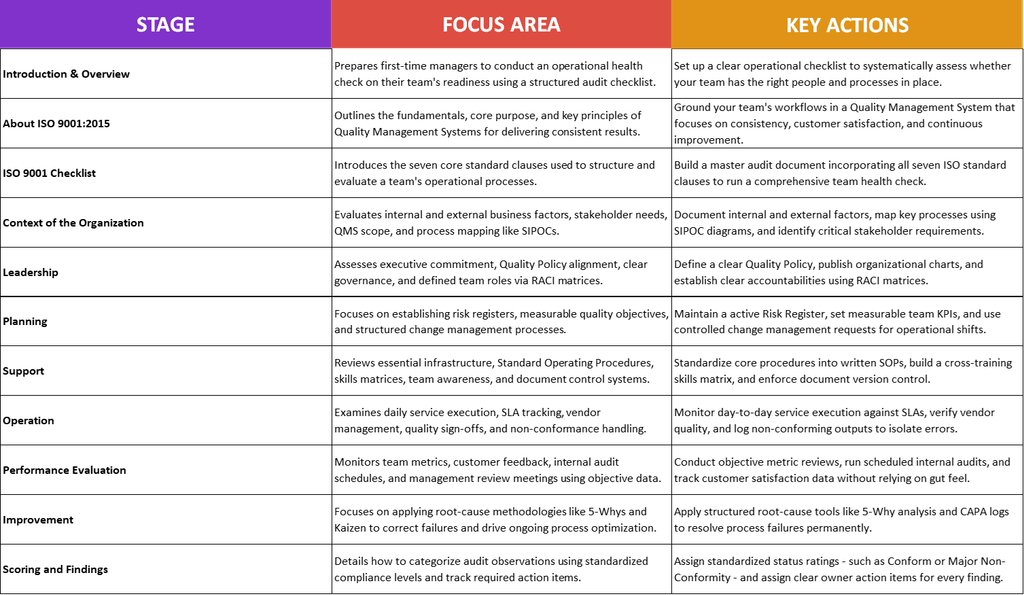
This ISO 9001:2015-based team audit framework helps first-time managers evaluate operational readiness across seven key areas – Context, Leadership, Planning, Support, Operation, Performance Evaluation, and Improvement – enabling them to systematically review processes against required evidence, identify operational gaps, score compliance levels, and establish root-cause actions to drive continuous improvement, team efficiency, and consistent service delivery.
Your First-Time Auditor Roadmap:
About ISO 9001:2015
ISO 9001:2015 is the international standard for building a Quality Management System (QMS) that ensures your team consistently delivers products or services that meet customer and regulatory requirements. It operates on a foundation of continuous improvement designed to create reliable, repeatable, and measurable workflows.
A Quality Management System (QMS) is a structured framework of policies, processes, documented procedures, and records that defines how an organization creates and delivers its products or services to meet customer and regulatory requirements.
The core purpose of a QMS:
- Consistency: Ensures every product or service meets identical quality standards every time.
- Customer Satisfaction: Focuses operational goals directly on customer needs and expectations.
- Waste Reduction: Minimizes errors, rework, and operational bottlenecks.
- Continuous Improvement: Provides a system for identifying the root causes of failure and fixing them permanently.
The 4 Pillars of the QMS Framework:

ISO has a very specific and targeted scope: to make sure companies deliver according to customer requirements and regulatory standards. To achieve this result, companies need a specific checklist to help them along the way. This checklist has been adapted to incorporate many aspects that reflect current business, people, and legislative requirements in today’s market.
In essence, these are the core principles ISO 9001 is based on:
- Customer Focus: Aligning all operational outputs to meet and exceed customer expectations.
- Leadership: Establishing unified direction and clear accountability from top management.
- Engagement of People: Empowering and training the workforce to contribute to quality goals.
- Process Approach: Managing individual tasks as interconnected systems rather than isolated silos.
- Improvement: Maintaining an ongoing, systemic focus on optimizing operations.
- Evidence-Based Decision Making: Using accurate data and root-cause analysis to guide changes instead of guesswork.
- Relationship Management: Actively managing vendors, suppliers, and external partners to ensure supply chain quality.
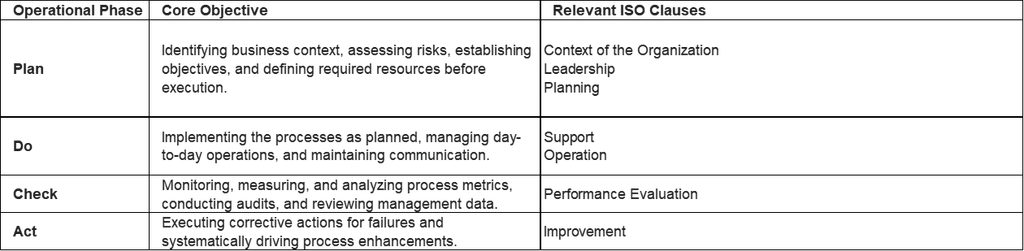
The best way to look at this is by using a familiar concept we have also covered: the PDCA cycle (full details in this article: The PDCA (Plan-Do-Check-Act) Cycle Explained).
ISO 9001 Checklist
To get you started, we need to review the basic structure of the ISO checklist you will be using. This is a simplified version of the checklist, created to help you get a quick health check of your team once you take over.
As a note beforehand: some of the items (maybe more than you think) might not be available, and it will be up to you to create and maintain them along the way.
The 7 items of your ISO audit are:
- Context of the Organization: Strategic context & stakeholder analysis
- Leadership: Top management commitment & governance
- Planning: Risk management & strategic planning
- Support: Resource management & infrastructure
- Operation: Operational execution & service delivery
- Performance Evaluation: Performance monitoring & evaluation
- Improvement: Continual improvement & non-conformance
Within each of these items, we have multiple sub-items that must be individually assessed. The scope of the audit is to check every item on this list and make sure your team is in good standing. We will take each item individually and go over all of its aspects.
Context of the Organization
The scope of this item covers strategic context and stakeholder analysis. In other words, this is where we check if internal and external issues are properly identified, if we have proper documentation showing who is responsible for which process, and if we have a QMS document, process maps, SIPOCs, KPI definitions, etc. If you need a bit of context or more information, you can also check out this article: SIPOC: Creating a Process Diagram.
To make things easy for you, here are the main sub-categories we need to review in this step, along with the requirements and evidence needed:
- Context Analysis: Have internal and external issues relevant to the organization’s strategic direction been identified and reviewed?
Evidence needed: SWOT/PESTLE analysis records, strategic planning meeting minutes, quarterly context review notes.
- Interested Parties: Is there a documented inventory of relevant interested parties and their specific requirements?
Evidence needed: Stakeholder matrix, customer contracts, regulatory mapping compliance documents.
- QMS Scope: Is the scope of the Quality Management System clearly defined, documented, and available?
Evidence needed: QMS Scope Statement, manual/intranet documentation, boundary conditions.
- QMS Processes: Are process inputs, outputs, interactions, sequence, and key performance indicators (KPIs) mapped?
Evidence needed: Process interaction map, SIPOC diagrams, process turtle diagrams, KPI definitions.
The best way to perform the audit is by using an Excel file containing all these items, with a box next to them for your findings. In this case, it would look something like this:

Leadership
The scope of this item is to ensure top management commitment and governance. In other words, we look for management reviews, resource allocation records, quality policies, onboarding materials, job descriptions, organizational charts, RACI matrices, etc.
This is a three-layer approach to team health that looks at three basic needs: leadership, quality, and roles & responsibilities. Every team needs these three items to function properly – lacking any one of them can cause a severe negative impact.
Here are the sub-categories, requirements, and evidence needed:
- Leadership & Commitment: Does top management actively demonstrate accountability for QMS effectiveness and customer focus?
Evidence needed: Management review minutes, executive messaging, resource allocation records.
- Quality Policy: Is the Quality Policy defined, aligned with strategy, communicated, and understood across the team?
Evidence needed: Published Quality Policy, staff interview verification, onboarding material.
- Roles & Responsibilities: Are organizational roles, responsibilities, and authorities clearly assigned and communicated?
Evidence needed: Organizational charts, job descriptions, RACI matrices, delegation authority logs.

Planning
This section is all about strategic planning and risk management. Here, we look at the risk register, mitigation plans, review logs, scorecards, KPI trackers, change requests, impact analyses, etc.
Planning is all about the basic project plan every leader must have in their team. It is a way of ensuring everything you need to track is where it needs to be.
Here are the sub-categories:
- Risks & Opportunities: Are actions to address organizational risks and opportunities systematically documented and monitored?
Evidence needed: Risk Register, mitigation plans, risk assessment matrix, review logs.
- Quality Objectives: Are quality objectives measurable, consistent with policy, updated, and cascaded to relevant functions?
Evidence needed: Balanced scorecard, KPI trackers, team objective documentation.
- Planning of Changes: Are structural and operational changes to the QMS planned and carried out in a controlled manner?
Evidence needed: Change management requests (CRs), impact analysis records, rollout schedules.

Support
This item covers resource management and infrastructure, in other words your work environment, operational procedures, competence, awareness, and documented information.
Support is a huge part of any team because its foundation dictates your team’s success. For example, a team without SOPs is by default at risk for high error rates, potential penalties, and waste generated from fixing mistakes. Many teams fail or struggle simply because aspects of their Support foundation are not where they should be.
Sub-categories we look at here:
- Infrastructure & Work Environment: Are necessary infrastructure, workspace, and process environments provided and maintained?
Evidence needed: Facility maintenance logs, IT uptime reports, ergonomic/workplace assessments.
- Organizational Knowledge: Is single-point-of-failure risk mitigated by capturing and sharing critical process knowledge?
Evidence needed: Standard Operating Procedures (SOPs), knowledge base, cross-training matrix.
- Competence: Are team members qualified on the basis of appropriate education, training, or experience?
Evidence needed: Skills matrix, training logs, competence evaluation records, certificates.
- Awareness: Are employees aware of their contribution to quality and the implications of non-conformance?
Evidence needed: Random staff interview checks, awareness workshop attendance, team meeting slides.
- Documented Information: Are documents and records controlled regarding creation, revision, distribution, and retention?
Evidence needed: Document control register, versioning checks on intranet/drive, archive policy.

Operation
This one is easy to understand: it’s all about operational execution and service delivery. Here is where we check process flowcharts, SOPs matching our processes, customer contacts, service level agreements, vendor lists, supplier scorecards, quality control sheets, work instructions, incident logs, etc.
This is the heart of your team, and the better documented and maintained it is, the better your team will perform. While it might seem strange, I have found many teams across my years of experience lacking in operational documentation. Some think they don’t need it because the team is well-prepared and knows what to do, some keep all the information isolated with specific individuals, and others simply don’t want to waste time documenting what they do. While the reasons are endless, the main goal is to keep operations on track, up to date, and frequently reviewed.
Here are the sub-categories:
- Operational Planning: Are operational delivery processes planned, implemented, and controlled using clear criteria?
Evidence needed: Process flowcharts, execution checklists, standard operating procedures.
- Requirements for Products/Services: Are customer requirements clearly captured, reviewed, and confirmed prior to commitment?
Evidence needed: Customer contracts, service level agreements (SLAs), order intake review logs.
- External Providers: Are third-party vendors and external suppliers evaluated, selected, and performance-monitored?
Evidence needed: Approved Vendor List (AVL), supplier scorecards, vendor audit reports.
- Production & Service Provision: Is service delivery conducted under controlled conditions with traceability where required?
Evidence needed: Service delivery tickets, Quality Control sign-off sheets, work instructions.
- Nonconforming Outputs: Are nonconforming service outputs identified, segregated, and controlled to prevent unintended delivery?
Evidence needed: Incident log, escalation register, non-conformance reports (NCRs).

Performance Evaluation
Unsurprisingly, this is all about performance monitoring and evaluation. It is probably one of the most ignored, biased, and poorly managed aspects within teams based on my experience across organizations over time.
While there is a lot of talk in the corporate world about how to track employee performance properly, the reality is that new managers are rarely trained on these aspects. Because of this lack of investment, we see a lot of mistakes such as: evaluations based on feelings rather than objective data. This is why keeping a very close eye on this item is probably the most important thing you will do in your role, as it directly impacts your people on many levels.
Here are the sub-categories we look at:
- Data Analysis & Customer Satisfaction: Are process performance metrics, SLAs, and customer satisfaction levels systematically measured and analyzed?
Evidence needed: Customer satisfaction survey scores, Net Promoter Score (NPS), monthly performance reports.
- Internal Audit: Are internal audits conducted at planned intervals to assess QMS compliance and effectiveness?
Evidence needed: Annual internal audit schedule, audit reports, lead auditor training credentials.
- Management Review: Does top leadership review QMS performance at planned intervals using comprehensive inputs?
Evidence needed: Management Review Board meeting decks, action item trackers, sign-off sheets.

Improvement
This section is all about continuous improvement and its associated methodologies, such as 5-Why analysis, root cause analysis, Kaizen, automation, etc.
Here are some articles you might find useful:
- Root Cause Analysis (RCA): The Starter Pack
- Small Process Improvements: The Kaizen Way
- 8 Types of Waste in Operations: DOWNTIME
- Value-Add Activity: First-Time Manager Handbook
- 5S for the First-Time Manager
- Mastering the 5 Whys (And Knowing When to Stop)
- Fishbone Diagrams (Ishikawa) for Complex Issues
In this item, we need to review the following aspects:
- Corrective Action: When non-conformities occur, are root causes identified and corrective actions executed to prevent recurrence?
Evidence needed: 5-Why analysis docs, Root Cause Analysis (RCA) records, Corrective Action Plan (CAPA) logs.
- Continual Improvement: Does the team actively drive process optimization and continual improvement initiatives?
Evidence needed: Kaizen logs, continuous improvement project reports, automation/efficiency dashboards.

Scoring and Findings
No audit is complete without proper scoring and findings. In the Excel file you create, make sure you capture both of these aspects.
Scoring should be straightforward; stick to a simple list of ratings you can assign to each audited item. In the examples provided, these are the definitions used:
- Conform: The process, activity, or record fully meets the specified ISO 9001 standard requirements and internal procedure guidelines.
- Minor Non-Conformity: A small, isolated lapse or single breakdown in a process or record that does not compromise overall quality, customer satisfaction, or system integrity.
- Major Non-Conformity: A total failure or systemic absence of a required control or process that directly poses a risk to product/service quality, compliance, or customer satisfaction.
- Opportunity Identified: An area where current operations meet minimum compliance, but potential exists to streamline, automate, or improve efficiency.
- Not Applicable: An ISO clause or audit check item that does not apply to the specific scope, function, or operational boundaries of the team being audited.
You also need to make sure you capture your findings, observations, and required action items.

With this done, you should be all set for your first audit. While some of the items mentioned here might be new to you, don’t worry too much right now – if you don’t understand what an item is, simply research it and try to build it on your own where possible. I will release more articles in the future covering these specific documents and frameworks, but for now, this will set you on the right path.
Auditing your team and checking if you have all these items in place is the best way to uncover current gaps, catch bad practices, and continuously improve.
Until the next article, stay safe, happy, and healthy!