
How do I know which process steps are actually worth doing?
Picture this: it’s 2026 and you just got promoted to a new role. You have a team that has been doing this work for at least 10 years. You start looking at what they are doing, how they are doing it, and why they are doing it. Some of the things make sense while others not so much. You have questions: why is this person doing this report like this, why is this process so slow, why are we going about customer approvals in this manner… many questions.
Processes are very similar to the way you make your own bread: it works for you, but that doesn’t mean it can’t get better. Sometimes you look at other people making bread and you have a realization: what if I do this step as well, instead of doing what I’m normally doing? Because we spend a lot of our time fixing issues and making sure things don’t crack, over time processes tend to get a bit out of date. This in turn leads to added steps that are either no longer relevant or create more work instead of making things easy.
To identify these “low-hanging fruits,” we need to check our process and pinpoint the value-add and non-value-add activities. In today’s article, we will be doing just that, helping you with a quick guide on what this is, how it works, and how you can start doing it from now on. Topics are:
- The Check: Why am I doing this again?
- The Customer Value Test
- Necessary Waste Vs. Pure Waste
- Streamlining Administrative Overhead
- Make Lean a habit – not a project
The Check: Why am I doing this again?
In a past article, we talked about the basic concept of waste (details here if interested: 8 Types of Waste in Operations: DOWNTIME). As a quick recap, waste is anything we do in our process that is not adding value, so the next question is: what is value-add?
Value is about the things we do in a process that actively contribute to increasing the worth of a product or service for our customers. To get a better grasp of the concept, value-add (VA) is identified by these 3 pillars:
- Customer wants to pay for it: If you add all the steps you are doing onto an invoice, the customer will pay for it as it contributes to what they care about.
- It helps transform the product or service: It digitally, physically, or structurally changes the product/service, bringing it a step closer to completion.
- First Time Right: It is done correctly the first time. Any rework or fixes are not value-add and as such must be eliminated from the process.
Now that we are a bit more familiar with VA, let’s talk about the core question used when we need to identify it: why am I doing this? It is a very simple, yet efficient question that can help you try to lock onto those pesky Non-Value-Adds (NVA) in your process. Using a mix of personal experience, your team, and Subject Matter Experts, you need to sit down and have a good old-fashioned brainstorming session. When you identify your VAs, you also identify the NVAs, meaning you can actually go into your process and start replacing, upgrading, or removing them completely (if no longer needed). This will make the process run faster, better, and eliminate waste (time and effort spent on doing activities that are not relevant or are annoying).
The Customer Value Test
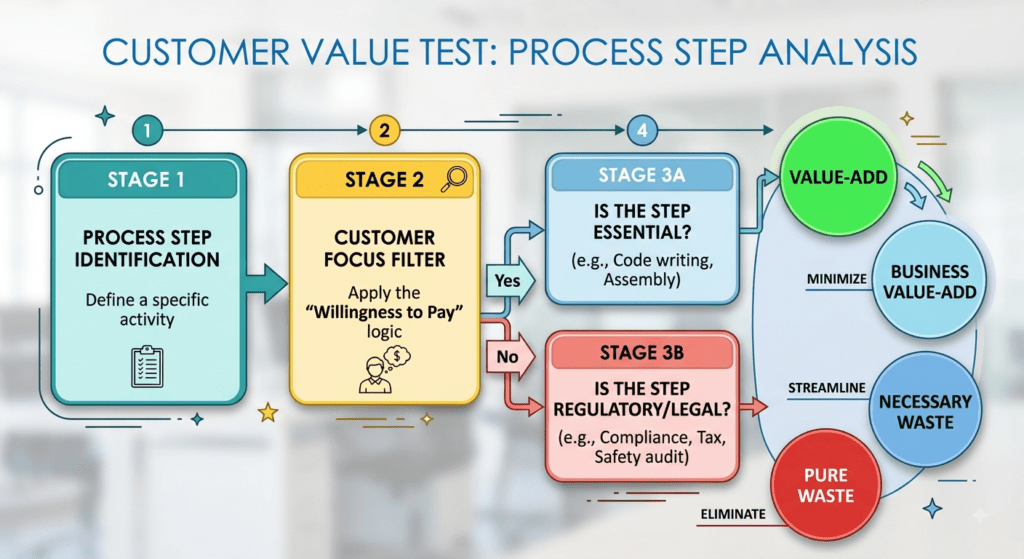
We have many ways to identify what is VA and NVA. One of them is the Customer Value Test. The idea is very simple: look at the process, put all the steps down, ask the essential question “is the customer willing to pay for this?”, check if you have any company or legal requirements for the ones they don’t want to pay for, minimize the business value-add, streamline the necessary waste, and from that, you will extract your pure waste.
Confused by all the steps? Don’t blame you, so why don’t we make it even easier for you? Let’s take a simple example and see what it looks like. You just want to feel fancy, so you go into a bakery and order a custom cake. Behind the counter, this is what is happening from a Value-Add and Non-Value-Add perspective, with you as the customer paying for said cake:
Value-Add
- The Step: Baking and decorating the cake according to your chosen flavor and design.
- Why it’s Value-Add: You specifically ordered a finished cake, so you are happy to pay for the ingredients, the baker’s skill, and the execution. It directly transforms raw flour, sugar, eggs, butter, etc. into the product you want.
Business Value-Add (BVA) / Necessary Waste
- The Step: Printing a food safety label and running your credit card through the payment system.
- Why it’s Business Value-Add: You don’t buy a cake just to get a safety receipt or swipe a card, but the bakery legally must follow health regulations and needs to get paid to stay in business. It doesn’t add taste to the cake, but it’s required to run the operation.
Non-Value-Add (NVA) / Pure Waste
- The Step: The baker accidentally bakes a chocolate cake instead of vanilla, throws it away, and has to start over from scratch; or the cashier takes 10 minutes looking for a pen to sign the receipt.
- Why it’s Pure Waste: Reworking a mistake or waiting around for missing tools adds zero value to you as a customer, and it isn’t legally required. It just wastes time and money, not to mention your nerves.
So, a simple schematic of this test would look like this:
Necessary Waste Vs. Pure Waste
Let’s talk about Necessary Waste and Pure Waste. Both are, as we’ve seen by now, things the customer doesn’t actually want. Necessary waste is, however, tied to your business (in the cake example above: label printing, using the credit card, etc.). As the process owner, you can’t skip this because it is tied to your business. While the customer might not want it, you must do it for many other reasons. With this, the best thing you can do is keep it lean and accept the fact that it’s part of the business.
Pure waste, on the other hand, is something you do not need or want in your process. It is the exact reason why companies use process mapping and value stream mapping: to eliminate it. Pure waste only delays the process more, creates a lot of frustration in your team, could cause escalations from your customer, and trigger unexpected reactions from people (an increased risk of attrition, for one – why stay in a company where things are done manually when you can go to another that does a better job at waste management?). Your first priority once it is identified is to remove it from the process. There are many options here, but these will be the subject of other articles. Continuous Improvement is a big concept with a lot of information; we take it step-by-step.
A very common mistake people tend to make is confusing waste with added value. How is that possible? I’m sure everyone has heard at least one person say something like “we’ve always done this task this way.” That, my friends, is the trap: the fact that people think doing something a certain way for many years automatically means it’s the correct way. People used to do a lot of things that were not really good for them.
Streamlining Administrative Overhead
What does this even mean, right? It sounds very new-age corporate, but it’s a very simple thing: there’s a lot of NVA in your teams all the time, actually. Many things in the corporate environment happen just because they think they need to. I can’t even tell you how many meetings I have attended over the years that should not have even happened: a meeting to check a new procedure, a meeting to review some slides, a meeting to see if we are aligned, a meeting to set up another meeting, a pre-meeting, a mock meeting, etc. Sometimes people feel we have too many meetings, and many of them are waste. Check your team’s schedule, see if they have any useless meetings added to their calendar, and remove them. You don’t need so much NVA; you can use that time to do something productive.
Do a check and see how many things people are doing that can be automated; you might be shocked at what you find. When I got my first team and was doing a “get to know the leadership” walk, I sat with someone who was doing weekly reports on quality checks. She was using a pivot table in Excel to extract the audit IDs, and then she was MANUALLY counting them using her finger to keep track. Such examples are really not exceptions, and you might be surprised by how many there are. The smallest things can be removed and/or improved by other means. Just a few examples:
- Create templates for different emails they need to send
- Help them with Excel and show them how to use a pivot table instead of manually creating tables
- Create different dashboard templates that can extract the information you need
- Show them how to use tool layouts for faster processing
And last, but most importantly: encourage your team to call out useless process steps without the need for a 1,200-word email. Make things easy and simple for them, and let them see you are open and willing to make life better. Be a leader, not an order giver.
Make Lean a habit – not a project
We will have a dedicated article (probably more) on Lean; however, the basics of Lean focus on waste and its removal from the process. In many companies, this is treated more like an individual project for improvement. They identify the waste, put the effort in, and treat it like a one-time event. Lean is much more than that: it’s a tool you can use as a habit. You can teach and coach people on why it should be done all the time, not just once per year. Teams that prosper and grow are the ones that keep evolving and investing in themselves; they don’t just stand around doing nothing. In this business environment, it’s the only way.
Of course, this will not come naturally because, as it is with any change, people are resistant. You need to attract them by showing the benefits. Here are some examples:
- Put a process steps review on the schedule once every 3 months and check if you have any additional waste
- Have recurring sessions on the benefits of waste removal: take 1 waste removal win you achieved as an example and talk about the benefits
- Create a Lean culture by talking to people, using yourself as an example, and showcasing how it worked for you (or other teams)
This concludes your first journey into Value-Add and Non-Value-Add activities in your process, another big and important topic you are now a bit more familiar with. In the future, I will have more articles on other ways of mapping this, but until then, remember: remove pure waste as soon as you find it, and keep Lean as a habit, not a one-off project.
Stay healthy, happy, and safe!