
How do I give immediate course-correcting feedback without defensiveness?
Feedback: the most essential and probably most difficult tool for a manager. There have been many tales told about it across the years, a lot of material available, so much posting on social media about the topic… and yet we still have managers that are not very good at it. In my opinion, this comes down to a simple fact, one I have mentioned before and in part the reason why I started this blog in the first place: not enough investment in the first layer of management when they need it. Because most first-time managers are just dropped into the fray, feedback is something they either catch on to with experience or read about from a quick Google search. I have covered a bit about the topic in this article: Effective Feedback: A First-Time Manager’s Guide. Today, however, I want us to make a deep dive into the specific topic of SBI.
What do I need – as a first-time manager – to know about the SBI Feedback Model?
The SBI Feedback Model helps managers deliver immediate, course-correcting, or positive feedback without defensiveness by deconstructing real-time conversations into three factual, objective layers: the specific Situation (the anchor), the observable Behavior (the camera angle), and the real-world Impact (the ripple effect), ensuring clear alignment, honest communication, and actionable next steps without subjective assumptions or emotional friction.
Your SBI Feedback Roadmap:
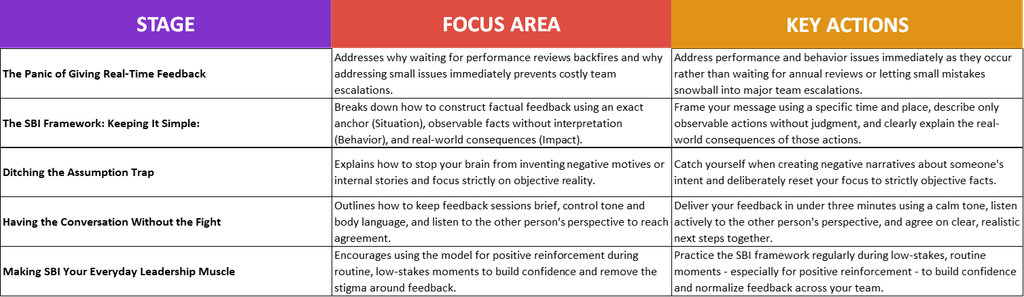
The Panic of Giving Real-Time Feedback
Let’s start out with a very common issue I see happening all the time with new managers: panic. They panic when they need to give real-time feedback, and most of them will just wait until the performance review to provide it. While I understand why some of them do this, the action itself (justified or not) is a mistake: the longer we stay on an issue without trying to take care of it, the worse it gets. Not providing real-time feedback when you have to creates a series of issues that you need to understand:
- Changes the perception of the person that should receive said feedback – they will keep doing whatever they’ve been doing, assuming it’s correct.
- It increases the potential for errors, since no one is talking about it right now.
- And the reverse: it can impact employee engagement and experience if they are doing something great and you are not taking notice and telling them about it.
Remember, we work with people, and because of this we need to always have one eye on the human aspect of the conversation, not just the numbers. Besides, there’s really no reason to fear real-time feedback, and whatever ideas you have about not using it are misplaced.
Small issues tend to cost more over time, and this only happens when you let them slide. I had to learn about this the hard way. Many years ago, I had this outstanding salesperson on my team; they could sell anything to anybody; a lot of times they helped push the result of the entire team a few days before month-end closure. I knew they had issues, but I always figured they were too small, not relevant right now, or just that “it’s not the right time to talk about this.” In my mind, there was always the “I’ll talk about it next month,” and so next month moved to the next, and then the next, until something bad happened. See, all those little things I was not talking about started to gather and grew into this very big, nasty escalation that took everyone by surprise. It took me and my team 3 weeks to fix this, with a lot of work, a lot of frustration, and very low engagement from my team. This was my failure, and because of it, everyone had to suffer. All because I didn’t want to talk about issues “right now.”
The workplace is sometimes impacted by defensiveness – it ruins the honest feedback aspect. This is because people either assume it’s bad to actually give honest feedback or because they feel it’s not right to receive it. Either way, feedback is just… feedback. There is no perfect way to deliver it, there are no 10 steps to great feedback… that’s just fancy wording to attract people to some article or topic. The reality is simple: use a proper framework for it, like SBI, make sure you are honest, and deliver it when you have to.
The SBI Framework: Keeping It Simple
The reason I keep mentioning this model of feedback lies in its simplicity: it’s not a complicated framework, it’s not something you need to spend hours on, and it’s not going out of your way to make it happen. It’s the most basic and powerful tool, and it works wonders for first-time managers.
The SBI model stands for Situation, Behavior, and Impact, and at its core it’s about deconstructing a specific situation into these 3 layers. It does this in order to properly frame the issue you want to address and make it easier to understand, relate to, and agree upon. There’s no point in giving feedback one-way; you need to agree to it, otherwise it’s just you and a monologue.
Situation
This is all about the exact context, the exact time and place. It’s also called the anchor, because without it the entire feedback feels out of place and general. This is something you need to avoid, because general feedback is a waste of time. Talking to someone at work about performance or behavior needs to be exact and specific, otherwise it’s just 2 people talking about general things. For example, when you hear your boss telling you something like “you’re too disorganized,” what does that even mean? Is it something I do 100% of the time? Is it because of my emails, my notes, my actions… what is he talking about?
Here are some key points to consider:
- Goal: Ground the conversation in a shared, indisputable memory.
- Key Technique: Specify when and where the action occurred.
- Bad Example: “In meetings lately…” or “You always interrupt people.”
- Good Example: “During yesterday morning’s 10:00 AM client presentation…” or “In this morning’s team standup when we were reviewing the sprint board…”
Behavior
This is all about the specific and observable actions. It is also called the Camera Angle, because it functions pretty much the same way: only talk about what you specifically can observe, don’t make anything up, and don’t add anything that is not there. Many mistakes happen here because as people we have this strange need to add things that were not really there, a sort of personal observation that only we manage to see. It can come from bias, from experience (or lack thereof), from exposure to specific trigger points, education, etc. Regardless of the root, it’s not something you need, so you must try to keep these interpretations away from you as much as you can. This is why SBI is an excellent model: it will force you to only state the actual observable aspects – not what you think happened, but what actually happened.
A few pointers here:
- Goal: Stick strictly to objective facts and avoid loaded adjectives or interpretations.
- Key Technique: Focus on body language, specific words used, or tangible actions taken.
- Bad Example: “You were being rude,” “You acted unprofessionally,” or “You got lazy with the report.”
- Good Example: “You cut off Sarah three times while she was speaking,” or “The deck was submitted two hours past the deadline with three missing financial slides.”
Impact
I have seen tons of feedback sessions done across the years without the most crucial aspect: the impact. If people don’t understand why whatever they did was good or bad, they can’t relate to it. Impact, or the Ripple Effect, does just that: it explains to the other person WHY the behavior matters; in other words, it explains the real-world consequences of the behavior.
When impact is not explained, people will treat this as something of minor importance; when this happens, the probability of the situation reappearing is increased significantly. Think of it like a small child that keeps trying to play with fire: they don’t understand why it’s not okay to do it, because they don’t relate to the impact.
Some pointers here as well:
- Goal: Connect the observable behavior directly to its tangible outcome or personal effect.
- Key Technique: Frame the impact around workload, project goals, team dynamics, or client outcomes.
- Bad Example: “You made everyone mad” or “You don’t care about our project.”
- Good Example: “Because the deck was late, the client didn’t have time to review the numbers, which delayed our sign-off by a week.”
An example of a complete SBI:
- Situation: “During this morning’s project kickoff meeting…”
- Behavior: “…you checked your phone and walked out twice while the client was walking through their specs…”
- Impact: “…which made the client ask if we were distracted, and required the rest of the team to pause the presentation to catch you up when you returned.”
By structuring feedback this way, you give the recipient a clear, factual picture of what happened, making it much easier to move straight into finding a solution together.
Ditching the Assumption Trap
Listen, we (people) just love to invent things, especially bad things. There’s something fundamentally appealing about the negative, the dark, the bad, the sinister. Maybe this is why people react so much to bad news, to negatively charged statements—this is why 80% of media is focused on the worst possible news instead of the good news – people just like it more. Because of this, especially in feedback scenarios, our brains just love to invent bad things. You might be looking at some minor error and think, “Ah, they did it because they know it’s bad and want to impact the team for some reason,” or “This person is trying to sabotage the operation.” Maybe it’s easier to create this movie-like scenario in our minds than it is to accept a very simple fact: things just happen.
People start creating these stories in their minds, and then it’s very difficult to separate yourself from them. This is why, from the early stages, SBI tries to mold you into a more objective perspective: don’t think about the “movie in your mind,” just think about what actually happened. Assuming something just because in your mind you have this entire cosmic plan does not make it real; it’s just something you think about. Now, I want to note here that it’s impossible to turn this off completely if you have it, so that’s not the issue. The hard part is to not focus on it and just direct your attention to what actually matters: the facts.
Having the Conversation Without the Fight
Another hard part of feedback is how to deliver it without the drama. Sometimes people get very wound up during these sessions, and what should be a quick thing turns into a full-on fight. To avoid this, try to deliver your feedback in 2–3 minutes. This way, you can only focus on the exact things you have in the SBI model, meaning you don’t have time to add other things or spend time on less productive discussions. It’s also important to note that feedback delivery should be done with the appropriate body language and tone, otherwise what should be a 2-minute thing turns into “You don’t like me” talk.
After you deliver your feedback, make sure you leave enough room for them. They need to share their point of view, and it’s important (for you and them). Hearing the other side of the story is a great way to compare notes (hey, you might be wrong!) and a great way to reach common ground. Don’t be that manager who delivers feedback and then turns their back on people.
And lastly, please agree on clear and realistic next steps together. Don’t just impose them; talk to the other person and see if you can find that middle ground for actions. Just make them clear and realistic, otherwise you are just adding words that have no meaning.
Making SBI Your Everyday Leadership Muscle
Don’t just use SBI (or feedback in general) for bad things, because it’s not just about what we don’t do – it’s also about what we do. You can use SBI for positive aspects, as it has the exact same impact when you do.
What many new managers lack is the practical hand and the confidence to deliver feedback. To help with this, you can start with low-key moments to build confidence and experience. Take every smaller aspect, make it an SBI moment, and then use it. Little by little, one here and one there… in a few weeks you’ll be an expert on feedback.
What people fear most in companies and from their bosses is feedback, because, unfortunately, this has long been associated with negative work aspects. If you want to be a great leader, you need to work on changing this perception. Make feedback feel normal and part of the business, not something bad.
Here are some examples of SBI, in case you need a bit more specific content.
Example 1: Missed Deadline (Operational)
- Situation: “During yesterday’s 3:00 PM sprint review meeting…”
- Behavior: “…you stated that the API integration feature wasn’t ready to deploy and hadn’t been tested yet.”
- Impact: “…which pushed our release back by two days and forced the QA team to work overtime this evening to catch up.”
Example 2: Meeting Conduct (Interpersonal)
- Situation: “In this morning’s client presentation when Sarah was sharing her slide deck…”
- Behavior: “…you spoke over her twice to answer the client’s question before she could finish her point.”
- Impact: “…which made our team look misaligned in front of the stakeholder and left Sarah feeling sidelined on her own project.”
Example 3: Positive Feedback (Reinforcement)
- Situation: “During the escalated support call with the account manager this afternoon…”
- Behavior: “…you paused, let the client explain their entire issue without interjecting, and summarized their key concerns back to them.”
- Impact: “…which immediately lowered the client’s frustration level and helped us reach a solution in half the usual time.”
Until the next article, stay happy, healthy, and safe!