
Why delegating tasks actually helps your team
Hey there! Feeling a bit like the “new kid on the block”? Do things feel a bit off, like something is just not right? Getting the impression that you might be missing something? Are you trying your best and yet the Universe just brushes you off? Well, you might be onto something. It’s really very common for a new manager to feel this way. Let’s give some context: you got this job, most likely, because you have great results, you are a people person, and because you were the best at the interview. This puts you in a very special box, but not in a bad way… necessarily. Since your background is one of giving 100% (even more) – good performer and all that jazz – there is a habit you have right now that is not doing you any favors. Mostly, it’s your mentality of the Individual Contributor. It’s that little voice in your head always telling you to just do things, fix issues, find solutions. When you move into this new role, you might be very tempted to keep doing the same thing: DON’T!
What should a first-time manager know about delegating tasks efficiently?
Transitioning from an individual contributor to a manager requires unlearning hands-on execution and the “Hero Complex” to focus on team success through coaching, effective delegation using the 70% rule, giving context over step-by-step control, and empowering employees to solve problems independently to drive collective output and prevent burnout.
You RoadMap for efficient task delegation:
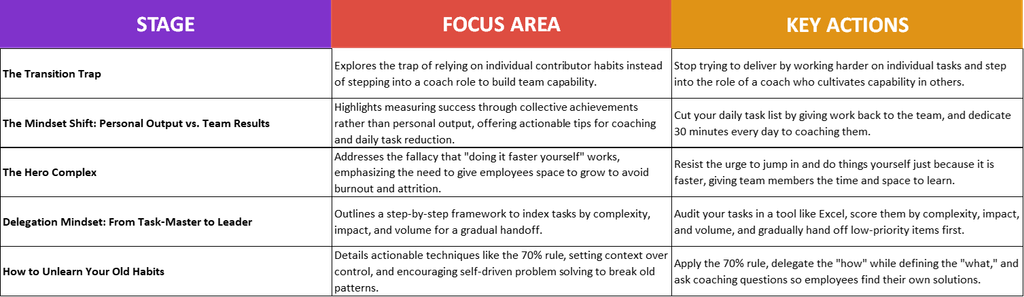
The Transition Trap
Starting your new role, stepping into leadership more specifically, brings with it a transition. As an individual contributor, you did a great job with tasks: planning, executing, finding solutions, improving, etc. When you step over to the leader’s side, things are a bit different. What worked really well for you before will not work now.
Most first-time managers start repeating the exact same thing in their new role. For them, nothing really changed: a new position, more responsibilities, but I still need to show I can deliver, right? Wrong! The way you deliver now is not by how hard you work with tasks and keeping up the “old way”; it’s about how you cultivate in others the same passion and capability. You are now the Coach, the person that helps others get to the same level. This is what is expected of you. When you continue with the same habits, a lot of things start going off-script. Here’s some data on that, if you’re curious:
- The Gallup CEO Study (1,432 Leaders Studied). Gallup evaluated the delegation talent of over 1,400 business leaders. Executives with high delegation capability generated 33% higher revenue compared to those with low or limited delegating habits.
- Harry Chambers Workplace Study (2009). In a comprehensive study on workplace micromanagement and task retention: 79% of employees reported experiencing non-delegation, 85% stated that a manager’s refusal to hand over ownership directly damaged their morale and job performance, and 91% of non-delegating managers were completely unaware that their inability to delegate was a primary driver of team member resignations.
- DDI Leadership Forecast & HBR Studies. DDI’s leadership benchmarking reports identified delegation as the #1 competency for preventing manager burnout.
The Mindset Shift: Personal Output vs. Team Results
The hardest lesson to learn as a new manager is the fact that your success is no longer measured by your personal output, but by what your team is delivering. It’s hard to learn this because it has a psychological effect on us: we need to give in to something beyond our control, to give the things we could control 100% before to a group of people. It’s hard to do, yes, but it is a must. Managers that hold onto this have the false illusion that they will experience the same results as they did as an individual contributor. Think about it in realistic terms: unhappy with how people are doing, so you are going to do the job of 20 other people? That is just not possible.
Since change is hard, you can try it with smaller things and keep building until you have a routine you can follow that works best for you and the team. Here are some tips and tricks I caught along the way:
- Give everyone on your team equal chances, even the ones you believe are not responsible enough.
- Make it your personal target to invest at least 30 minutes per day coaching people on the team on how to improve the things they are doing (and where you feel the need to step in and correct).
- Every morning, look at your to-do list. Whatever tasks are there that should be done by your team: cut them by at least 50% and give them back to the people who should do them.
- If people make mistakes, offer them proper feedback on how to improve (link here).
The Hero Complex
In line with the information I wrote about in Part II, the Hero Complex is that impulse that keeps telling you the same thing, over and over again: “I can do it faster.”
This, my friends, is the biggest fallacy ever in the history of management. Firstly, it’s not aligned with the core scope of management; secondly, it shows how little you think about your team; and lastly, it’s simply not the way to approach things. Remember, your job is to make sure that people have the space to grow and become better at what they do. If you keep doing their job, they will never reach that point. Additionally, over time, the amount of added stress, pressure, and failing results will burn you out and cause attrition (yes, believe it or not, people don’t stay in teams with heavy micromanagement and unsupportive environments).
Resist the urge to say that, and start acting the exact opposite: give people the chance to learn and get better. Keep in mind: getting better is not a one-time thing, it takes time and real effort. You need to be prepared for this. Just saying it is not enough!
Delegation Mindset: From Task-Master to Leader
Moving away from the role of task-master to leader is a hard one. It takes everything you have to fight these impulses. To help you achieve this, simple but frequent steps can be taken. Think about it as a transition: you slowly surrender to something new, a change of sorts that is coming that nothing can stop.
Here are some small tricks I learned during my journey in leadership:
- Make a list of all the things you are doing for the team. Put as much as possible in there, and make sure you have everything (it’s best to do this in Excel).
- Spend some time on the list and start assessing each task based on Complexity, Impact, and Volume. Use these 3 (or find your own categories, whatever works for you) to establish a priority index.
- Use the priority index to slowly ramp up delegation: start with the easiest tasks with low impact. Then move to the medium-complexity ones, and so on.
- Don’t just hand them over and be done with it: once a task is handed off, go and help that person with it. Explain the way of working, give them tips and tricks, etc.
How to Unlearn Your Old Habits
And here we are: the most essential part. Unlearning old habits is the major step you need to take to finally close this chapter. It’s a long and hard process, but with help and proper practice, you can do it.
Shift your dopamine trigger. As an individual contributor, your brain rewards you with a dopamine hit once you finish a task. As a manager, you no longer have that same feedback loop (at least at the beginning). To correct this, you can establish a practice at the end of every week to perform a 5-minute audit of your completed tasks. Categorize them into two buckets:
- Direct Output: Things only you worked on.
- Leverage Output: Tasks you delegated, unblocked, or coached others through.
Apply the 70% rule. This one ties to perfectionism, another bad habit people used to praise a few years back. This is nothing more than fear in disguise (the fear that someone else will not perform the task according to your personal standards). To move away from this, use the 70% rule: if an employee can perform the task 70% as well as you currently can, delegate it immediately. Room for improvement? Of course there is; the remaining 30% falls under your responsibility now through coaching, feedback, etc.
Practice Context Over Control. See, most new managers, when they delegate, have the tendency to micromanage – so they start giving out step-by-step instructions. It’s OK to transfer the Why and What, but leave the How to them. Explain the overall process, explain the core principles, the impact, etc., and leave the rest to the employee. One task can be done in multiple ways, you know? It doesn’t mean they are doing it wrong.
Start using “Have you found a solution?”. When an emergency or tricky question pops up, a former individual contributor’s default setting is to jump in and solve it immediately. This creates “learned helplessness” on your team. Ask the person to first try to find a solution on their own and then come back to you. You need to stop telling people what to do and start teaching them to look for solutions. If they still can’t find the solution, use coaching questions to help them find the answer (“What have you checked so far?”, “What do you think is causing this?”, “What do you believe could solve it?”, etc.).
Final Thoughts
While behind a simple topic like delegating we see so much research and available information (which might feel a bit discouraging), don’t be. It’s really a matter of habit change, something we do all the time without even realizing it. Every habit you change will trigger an old habit to go away and a new one to take its place, so this is no different. It is a job change, after all.
Keep your mind on the prize: invest in your team, improve how they do things now, and you will reap great benefits later on. Shift from “I’ll do this myself” to “Let me show others how to do it,” and you will be greatly impressed by the outcomes you generate.
In case you missed them, here are a few articles that will support your journey as a first-time manager:
- Effective Feedback: A First-Time Manager’s Guide
- From Peer to Boss: How to Lead Your Former Teammates
- Root Cause Analysis (RCA): The Starter Pack
- Performance Management Dashboard: Essential Starter Tips
- Employee Performance Issues: The Early Action Guide
- The First-Time Manager Starter Pack: Days 1–30
Until the next read, stay safe, healthy, and happy, and help others as much and as often as you can!