
How to manage performance issues early and constructively as a first-time manager
The cornerstone of a leader is how well their team is performing, but performance isn’t as simple as “ahh, you have a good, solid, hard-working team.” Across my years of experience, I have seen many times how great, solid teams experienced a change in management and went from high-performing to the bottom. The decline is swift and difficult to recover from. The real question here is: why is this happening? Why are some teams really great, while others are not so much? To answer this question, we need to take a deep dive into a topic that gets a lot of traction on social media, but is not sufficiently applied inside organizations.
What should a First-Time Manager do to spot and fix underperformance early?
Making sure underperformance is caught early and fixed constructively requires understanding on why you need to spot it early, preparing for the actual conversation, using a proven feedback model (like SBI), turning the discussion from blaming to fixing it together, and follow-ups and documentation.
Basic Underperformance Roadmap for the first-time manager
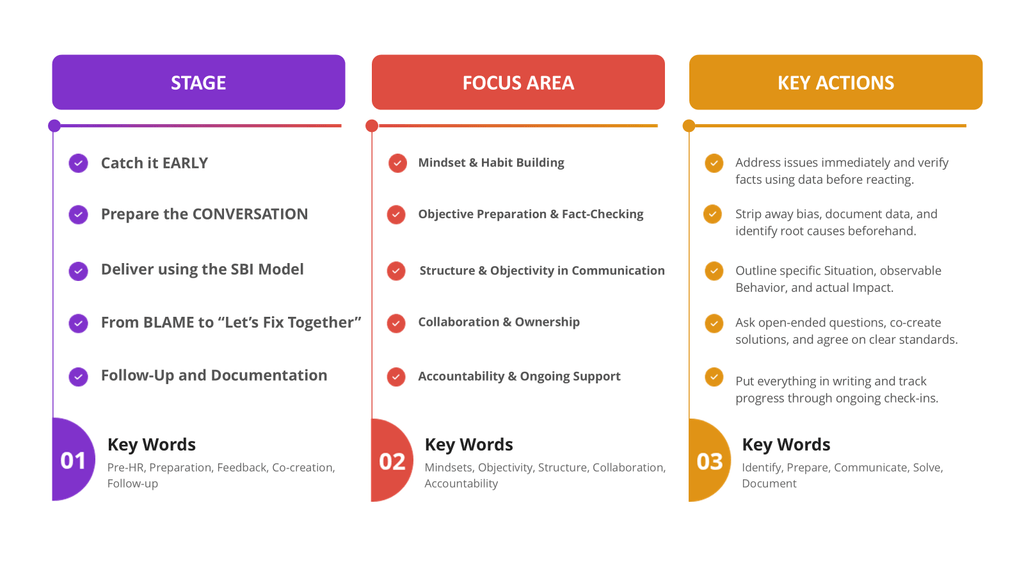
Catch It Early: Why Pre-HR Action Matters
A common mistake for a first-time manager is believing that performance issues can be dealt with at any given time. On the other hand, it’s very easy to miss them if it’s your first time, everything is overwhelming, and pressure is coming from every possible angle. I get it! It’s hard to manage every little nook and cranny of the team and keep your attention focused in every corner.
To fix this and be better prepared, there are some simple habits you can start building. The trick is to apply them in a way that serves you, your team, and your specific situation. In management, there is no such thing as a universal fix. We don’t have a general framework you can follow to the letter that will make everything magically fine regardless of the process and people.
Habit One: Remove the Cost of Waiting
When it comes to performance issues, even the simplest and most easily ignored aspects can turn into major team disruptors. The longer you wait, the worse it gets. Waiting on them is like looking at a small leak in your ceiling: the less work you do on it, the bigger it gets. Waiting also impacts both the business and your people, as small issues tend to affect operational costs (attrition, penalties, fines, loss of revenue) and the employee experience (elevated stress levels, pressure to deliver more, fixing errors, overtime, etc.). This is why your first habit should be shifting your focus from “I will manage this tomorrow” to “Let me see what I can do about this today.”
Habit Two: Shift Your Mindset
Many first-time managers are under the false impression that early intervention on performance issues will be interpreted by the team as a form of punishment. It’s not! We need to shift this perception and start thinking about it from a different angle: What can YOU do NOW to help this person do better? While underperformance is a problem, the process of helping that person improve shouldn’t be a negative experience.
Habit Three: Distinguish Signs vs. Assumptions
Do not overreact. A very common trap for new managers is reacting and overreacting to every little detail. We must remember a simple reality: we work with people, not machines, and people have good days and bad days. There is no such thing as “leave your problems at the door when you come to work.” That is old, outdated, and unhelpful advice. People will make mistakes – this is a given, and it happens all the time regardless of tenure or experience. It’s normal, it’s human, and it’s a fact of nature.
What can change is you. Instead of reacting to everything, take a step back and make sure the signs aren’t just your own assumptions. Do your homework, check the facts, and use data. Don’t assume, even if it looks like an obvious mistake. Due diligence and proper investigation are essential before taking action.
Let’s say a team member receives an escalation:
- First, ask what happened to get an understanding. Don’t react; just help that person fix it. It’s crucial to fix the immediate issue before it gets worse.
- Do your due diligence: Investigate what happened, when, and why. Perform a proper Root Cause Analysis (RCA) and look across different layers (personal factors, tools, systems, procedures, client expectations, etc.).
- Check your data: Review reports to identify trends. How many errors occurred per month over the last 6 months? Are there any older improvement plans or notes in their performance file?
- Build a complete overview of the entire situation before speaking with the person again, and make sure to get their perspective.
Preparing the Conversation: Before You Speak
Let’s assume we have reached a point where we need to address a performance issue. Before you even begin to plan the discussion or any actions, you need to strip away your bias. A lot of people talk about bias, but it’s a fact of life: we all have it, and we must deal with it.
How many times have you heard comments like “They just don’t care” or “Well, that’s just something they always do”? This happens because it’s easy to label someone rather than understand what is causing the behavior. You need to fact-check your bias and stop making assumptions.
Documentation
Your second and equally important step is to document all aspects in an informal and objective manner. Use as much data as you can and look at the bigger picture (workload volume, task complexity, employee seniority, special circumstances, etc.). The better prepared you are with factual data, the better equipped you will be to help that person. A lot of new managers skip this step or gather two or three reports and call it a day. It requires more depth than that.
Root Cause Hypothesis
A good plan addresses the root causes behind an issue and tests hypotheses on why it is happening. As mentioned with documentation, examine the problem from multiple angles—not just strictly through SLA, KPI, or error rate metrics. Learn more about RCA in this article: Root Cause Analysis (RCA): The Starter Pack.
Delivering Constructive Feedback: The SBI Model
SBI stands for Situation – Behavior – Impact. For a first-time manager, this is an excellent tool because it forces you to analyze the problem objectively:
- Situation: Anchor the context. Define when, where, and what specific scenario you are referring to.
- Behavior: Describe observable actions without using vague buzzwords (e.g., avoid saying “you’re unorganized”). Use objective statements like “you missed two deadlines this week.”
- Impact: Explain the ripple effect of those actions on the team, customer, or project. This step is often overlooked, but when people truly understand the impact of their actions, they become much more mindful in the future.
Turning the Discussion into a Joint Problem-Solving Session
Simply telling someone how to fix things isn’t enough. You need to guide them and turn a classic “You did this wrong, stop doing it” conversation into “We have this situation, let’s work together to find the best solution for you.”
Keep in mind that what works for one person will not necessarily work for another, which is why feedback must be tailored to the individual. Here are a few key tips:
- Ask before you tell: Don’t just dump a list of issues on the employee. Have a dialogue, ask open-ended questions, and uncover the root cause together.
- Co-create the action plan: Involve them directly in building the solution rather than handing down a rigid plan.
- Set a clear benchmark: Define what good performance looks like and get their sign-off. When an employee agrees to the standard, accountability becomes much easier to maintain.
Follow-Up and Documentation: The Most Ignored Steps
In my experience, the most vital steps in managing performance are often the ones people skip: follow-up and proper documentation. Some managers leave things informal, some don’t bother following up at all, and others only do the absolute minimum.
The truth of the matter is this: every performance-related issue must be documented.
Remember these words: If it’s not in writing, it never happened.
Without documentation, you are left with hearsay – you say one thing, they say another, and no real progress is made. Make sure you capture meeting minutes, log emails and key communications, and save records in a secure location. Create a dedicated, well-labeled folder for each team member to store relevant notes and emails systematically.
Equally important is the follow-up. After any performance discussion, stay engaged. Give people ownership, empower them, and reinforce the message that “you are not doing this alone.” Employees need to see that you are actively supporting their progress. If things don’t go perfectly according to plan right away, don’t panic. The goal is continuous improvement, not punishment.
Stay healthy, stay happy and help others as often and as much as you can!