
How do I run my first 1-on-1 as a first-time manager?
Worried that you won’t run an effective 1-on-1 meeting on your first try? Afraid of what you might say? Not very sure on how to structure it? Well, then this is the article for you, my friend. The first-ever 1-on-1 is something all new managers have concerns about. Like you, I also had these same thoughts when I had my first team. I had all sorts of ideas in my mind, had at least 5 pages of layouts, words to say, was asking around the more tenured leads on how to do it… it was a mess. But that was then, and now you have many tools and research that can help you along the way. As a first-time manager, maybe you are thinking right about now that instead of doing all this research, you could just go in, wing it, and see what happens: DON’T! You are at the start of your new role, so it’s important to read more and act less, at least until you have a better grasp of what the role is and how many capabilities you have.
What should a first-time manager know about an effective 1-on-1?
To help new managers shift from personal output to team success, running effective 1-on-1s is done by establishing a purposeful meeting cadence, setting clear expectations, using structured frameworks like the 10-10-10 rule, avoiding common traps like micromanagement, documenting action items, identifying long-term performance patterns, and encouraging upward feedback to build trust, foster growth, and improve team engagement.
Your firs 1-on-1 RoadMap:
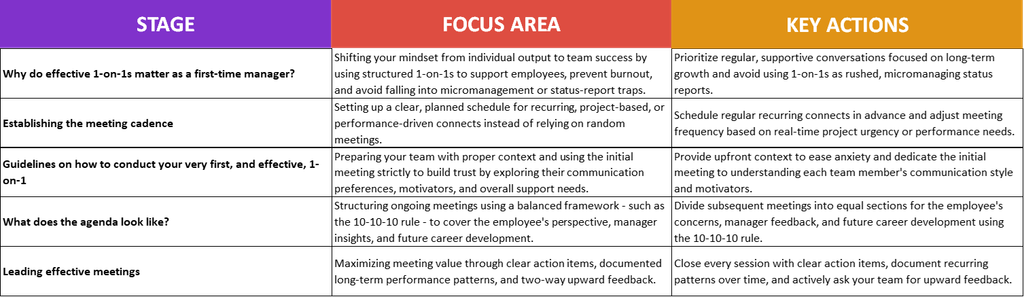
Why do effective 1-on-1s matter as a first-time manager?
It’s a very good question! And you are right to ask it. You can probably just go in and see what happens (tried and tested method, as they say), or you could replicate whatever former bosses were doing, have a simple structure, and follow that. There are many things one can do, but the truth of the matter is you’ve never done it before, so there’s no guarantee it will have the result you expect it to have.
Remember, we are talking about the human aspect here, and it’s complicated and doesn’t have a simple answer. Your new job brings with it a very important shift: from individual contributor to leader. You can no longer measure success as directly linked to your personal output. Now, success is about the team’s output. This is important because the 1-on-1 is your primary tool to achieve that success.
So, what is a 1-on-1 anyway?
It’s a frequent connect you will have with each team member in which you help and support said member. That simple. A 1-on-1 is not about telling people what they did wrong, and it’s not about time wasted with endless discussions. This is the time you reserve and use in both your and your team’s best interest. Take advantage of this time, have a proper plan and structure, make the best use out of it, and use it to improve that output that defines your success.
The trick, however, is to make sure you run these meetings effectively. Many new managers just “go with the flow” and use this time either as something they need to mark off as part of an HR checklist or because it’s part of a process and they must do it. Few, however, understand that this time can be used to plan, coach, and invest in your team. When the meeting is not effective, you get a lot of waste, and here is what that waste looks like:
- 50 minutes of talk about nothing: no actions, no coaching, no help… just talk about minutia.
- Added layer of frustration for both you and your team because you had these connects and nothing really came from them.
- Ineffective 1-on-1s tend to transition into the “micromanagement status report” very fast, I might add.
- Issues stay hidden until they become crises.
- Employee engagement drops.
Here are some small tips to help you run these 1-on-1s like a pro:
- Don’t make it a status report-out: keep the conversation going and ask open questions, not “did you send that report.”
- Do not rush through the agenda: take your time and let people see you are there for them.
- Do NOT RESCHEDULE! If there’s one thing people really hate, it’s a person who says they will do one thing and never does it. You made a schedule; keep it.
- Shift discussions from “the tactical now” to the strategic future: use this time to help people improve in the future. Yes, the now is important, but the future is your direction, not the past.
- Document – Document – Document. The “3 most important words” in a 1-on-1. Don’t just sit there talking without taking notes or making proper follow-ups. Make sure you capture the key points, the actions, and deadlines, and follow up on them. Show people this time is for them.
Establishing the meeting cadence.
A faulty aspect for the new manager when it comes to 1-on-1s is the cadence. Many don’t know how to set them up and rely mostly on random connects added here and there. This is a no-no. These meetings must have a purpose, and to do that, you need a good plan. Take a look at your team, performance, situation, and any relevant details, and try to create a list of priorities. This list will help you establish what, who, and when. Here are some tips on this:
- General connects: For example, monthly ones. You can just schedule them in advance each month. Look at your calendar, select a period with lower volume (also think about your team, not just you), and put them in every month for the next year.
- Project-based connects should reflect current reality: If something needs to be done in a week, add power-connects every day. Just schedule 10-minute connects with each person involved and use this time specifically for that.
- Performance-based connects should be done according to the on-the-ground situation: If this is an improvement plan situation, then maybe you add them weekly. If it’s a general performance situation, maybe you put 2 per month, or if it’s an urgent/escalation type of scenario, maybe you add them daily. It’s really up to you and your ability to decide and plan.
Guidelines on how to conduct your very first, and effective, 1-on-1.
The first and most important thing you must do is provide the context. Don’t just send out the invitation without explaining what you will talk about. When bosses schedule connects without providing context, it makes people very anxious, and you don’t want that. If you plan on sending invites out to the entire team (say, for general monthly connects), then send an email to the entire team and let them know this will happen, or tell them in a team meeting. This will set the context, help ease tensions, and answer a lot of questions even before the meetings start.
The second thing you must establish is the connect structure – the script, if you will. To be truly effective, you need to have a solid structure. This must include at least the following:
- The Purpose: Explain that this is not a police interrogation. This is their time, and you will use it to grow, invest in, and support them.
- Communication: Since it’s your first connect with this person, you must understand what they prefer when it comes to communication. Some people respond better to emails, others to small chats here and there, and so on. Find out what they want and how they would prefer to receive feedback from you.
- Motivation: Ask open questions and find out what drives them. What does a good week look like for them? What would they want to change in the process right now? What is the most important thing for them at the job? What defines a bad situation for them?
Your first connect is about getting to know the person. Stick to this plan and don’t go crazy with over-planning, 5-year career paths, and all of that. Keep it simple, keep it about them, and show them it’s a time specifically dedicated for them.
Under no circumstances do any of the following:
- Talk about other people from the team
- Add more pressure on the person
- Talk about their performance (you don’t even know them yet)
- Try to establish dominance by imposing an “I’m the boss now, you do as I say” attitude
- Create tension by opening debates
What does the agenda look like?
So, we know the first one needs Purpose, Communication, and Motivation. What happens after? How do you structure the 1-on-1s after the first one? Since the first one is unique, all others are more or less a copy/paste of the second one. You will find a lot of material out there, but the basic structure is this: employee’s perspective, manager’s insight, and development. This is your basic structure for all 1-on-1s that are not the very first one.
A simple rule, if you need something more specific, would be the 10-10-10 rule. It looks like this:
- First 10 minutes: Employee’s Agenda. Here, you let them talk about their concerns, ideas, and questions.
- Next 10 minutes: Manager’s Perspective. Use this time to provide feedback (link here), talk about priorities, strategic updates, and so on.
- Next 10 minutes: Development. Do not let a 1-on-1 go to waste by not talking about the future. Check broader goals, learning opportunities, blockers, etc. This time must be spent on how the individual will evolve in the future.
Leading effective meetings.
The last aspect you should know right now is how you make your meetings effective. Now that you have a basic grasp of what a 1-on-1 is about, here are some points you can use to make better use of your meetings. Let’s look at how to improve on them and take them to the next level.
Action items and accountability. One of the biggest mistakes new managers make is ending a session without establishing the action items and who is responsible for them. Take the last 3 minutes of the meeting and use this time to do a quick recap of who is doing what.
Patterns over time are very important. At the start, I told you the 1-on-1 is the single most important tool you will be using to reach success. Since you now know documentation is the cornerstone of the 1-on-1, start looking at patterns over time. If specific topics show up multiple times (like burnout, a procedure not working, volumes of work not being equally distributed, etc.), mark them and take action. From these connects, you will build a pool of improvements and risk mitigations over time (well, if you document them).
Upward Feedback is a must. Check with your team and ask them for feedback about you. What can you do better? What should you stop doing? How can you help them improve?
Now you are all set. Try to be relaxed, take it easy, and remember you are talking to a fellow human, not an alien. Take a deep breath, focus on your structure, and show them you care.
Until the next article, stay healthy, stay happy, and be kind to others!