
How do I catch operational risks before they turn into major crises?
Operations can be a messy job, there’s no doubt about it! People managers, SMEs, and day-to-day agents deal with an enormous amount of data, unstructured processes, demanding customers, pressure to decrease costs and increase efficiency, and much more. In the middle of all of this, the opportunity for a very special circumstance will – inevitably – appear: the risk. When we deal with so many things at once, or when we have a very complicated process… or simply because we are human and it is just a statistical probability at a certain point.
The other side of the issue is that risk is everywhere: there’s no single place on this planet without risk, so the concept itself is not the issue. What people need to focus on is risk management: how you deal with it once it is there. Many leaders fail here: they have the proper foundation, they go through the experience, but they don’t quantify it as it should be. It is here where a very relevant and essential question will take shape: what should a first-time manager understand about operational risks, and how will this help them in the future?
Operational risks are an inevitable reality driven by process complexity, high volumes, or simple human probability. By proactively tracking, scoring, and mitigating risks through a simple Risk Register – rather than relying on memory or constant firefighting – first-time managers gain clear prioritization and control. This proactive approach turns chaos into structured governance, protecting operations and setting up future leadership success.
In this article:
- The Risk Register: A simple risk register replaces unreliable memory and gut feelings with a clear, written system to track, prioritize, and proactively manage operational risks instead of constantly fighting fires.
- How to Identify the Risk: Managers can surface hidden process risks by facilitating team brainstorming sessions, mapping out bottlenecks and single points of failure, and examining vendor dependencies and technical handoffs.
- How to Score the Risks: Combining probability and impact scores creates an objective Risk Score that gives first-time leaders a clear, structured roadmap for prioritizing where to take immediate action.
- Mitigation Planning: Effective risk mitigation requires defining clear preventive and contingency actions while assigning specific owners across the team to drive shared accountability.
- Risk Review or Governance: Maintaining ongoing governance through regular reviews and transparent escalation of critical risks to senior leadership ensures long-term operational stability.
The Risk Register
In any healthy operation, and for any experienced and well-trained leader, there is a simple file that is – above all else – very well kept: the risk register. The concept is very simple: every single potential or real risk you have or can identify is tracked in it, along with the impact, the mitigation, ownership, and any other piece of information you might need on it.
Good leaders keep these types of files because they offer something that the “naked eye” or the “gut feeling” will not always see clearly: areas of potential (or actual) danger for the process and how to deal with them. While I do agree that some of the risks can be easily remembered, it’s not a very good practice to do so – meaning keeping everything you know just in your mind. High volume spikes, chaotic month closures, and any other harder times will for sure impact your capability to remember whatever information you have in your mind, so it is better to have it written down.
The register itself will also offer a very unique opportunity when it comes to prioritization. Based on different impact lenses, you can create a new way of looking over potential or actual risks on your process, having a clear method of prioritization. This helps you, your team, and the business continue in a much more organized way, since you have a better view of what will happen and how you plan to approach it. The alternative is, of course, to just react naturally to whatever risk comes and leave things to chance. In management, you never want to do that – the more things are left to chance, the worse it is for you.
Finally, I do want to mention the constant firefighting versus the proactive approach when dealing with risk management, as this will make or break your chances of success as a leader. When we focus a lot of our time continuously fighting left and right on different risks and red areas, we have no real time for that proper management that we seek so much: investing in people, improving the process to make things run smoothly, taking team engagement to the next level, adding more value to the business, and many more like it. What some leaders who choose the more chaotic way end up doing is constantly fighting for today without thinking about tomorrow.
Because of all these aspects, great leaders keep the risk register as one of the most valuable files they have: proactive identification and mitigation of issues, and lessons learned based on past experiences that will help them in the future.
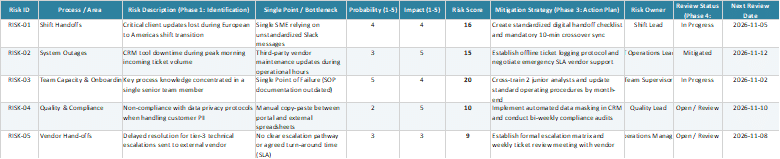
Here is an example of a simple Risk Register:
How to Identify the Risk?
On the road to building your own register, we always start with the most essential part: identifying the risks. There are many areas and/or layers to this part of the process, so let’s take the ones that are usually the most “looked” at when it comes to identification (or the source of risks).
Brainstorming would be your first one, yes – classic, simple, and elegant. This very common technique can make a real difference in your day-to-day activity if you know how to use it. Such is the case with risks, since you can use your team, experts from your team, or whatever mix you feel is the correct one to start a session where you talk about the potential risks from your process (or actual ones).
To make a brainstorming session successful, there are a few things – especially as a first-time manager – you should be aware of:
- You are there to be the “event coordinator,” meaning it is your job to keep the conversation going and people engaged.
- If you want just your team’s perception of risks, do not insert your own thoughts or opinions into the conversation. This means you need to stop yourself from adding any personal comments or remarks that might end up changing the team’s narrative. Let people discuss organically.
- Make sure everyone at the table has a word in: sometimes the more extroverted characters tend to take control and leave less-imposing personalities outside the table.
- Note everything people are saying (meaning write it down, not just a mental note).
Single points of failure and bottlenecks in your process would be your next step on the way to risk identification. This one is a bit easier to manage if we consider that your project and/or team have arrived here by following a proper structure and way of working. If that is the case, by the time you start to think about risk identification, your process should already have process maps and SIPOCs.
These are your first stop, as a great many things can be found here, such as waste, bottlenecks, potential problems you don’t see with the naked eye, another layer of impact on your business or process, etc.
Having a different way of looking over the process is a great way of dividing what value-add and non-value-add activity your process has. This can be another source of valuable information for you when it comes to the potential or actual risks of your process, since (at times) non-value-add can create a lot of room for bigger, more troublesome issues – if left untouched.
Vendor dependencies and technical handoffs should be your last stop (at least from the list of “most common places to look at”). Here you will find a lot of areas with “gray” that might make or break something, layers that people didn’t really look at properly, and situations that – when the process was constructed – people didn’t think about. Because of all these aspects, many risks can be identified, and with proper planning and good management, mitigated.
How to Score the Risks
Scoring identified (or potential) risks is mostly done using a double-layer approach, with one layer focused on the probability of said risk actually happening, and another layer about the impact of the risk. The product of these two aspects would create a Risk Score that you – the leader – can use to prioritize, take action, and decide next steps.
Probability is all about how likely it is for the specific risk to appear. The real question here is how do we mark this: do we use some sort of complicated statistics formula, or is it a “gut feeling” situation? While neither or both can be true, the best way to look at this will depend entirely on your business, personal experience, customers, bosses, etc. We can’t (and won’t!) put all types of businesses in the exact same bucket when it comes to risks.
From my own experience, the setting of risk probability is a mix of the personal experience of the leader and a team of process experts who together establish, usually on a scale of 1 to 5, the likelihood of the event happening (with 1 being not likely at all and 5 being a 100% guarantee). If you feel a more mathematical approach is needed for your project and/or situation, feel free to improvise and create your own. After all, the fun is in taking whatever information is out there and making something that works specifically for you.
If this helps you a bit more, feel free to use it:
| Scale (1-5) | Probability Definition |
| 1 | Rare (< 10% chance) |
| 2 | Unlikely (10% – 30% chance) |
| 3 | Possible (30% – 50% chance) |
| 4 | Likely (50% – 80% chance) |
| 5 | Almost Certain (> 80% chance) |
Impact works similarly to probability, in that usually it is selected on the same type of scale. The concept of impact describes the potential effect that the risk will have on the business, starting with negligible (meaning no actual impact on your customers or team) and ending up with critical (when we talk about severe disruption or financial loss).
Leaders and process experts must be very mindful when establishing the severity of a risk, as an incorrectly assumed impact can have a very different outcome on your entire plan. Understand that this is not just about how you score some risks in a file, but it’s also about creating a plan for the future. If you have the wrong direction for your plan, nothing good will come out of it.
Here is a template on risk scoring you can use if you find yourself without inspiration:
| Scale (1-5) | Impact Definition |
| 1 | Negligible (No customer/team impact) |
| 2 | Minor (Slight delay, quick fix) |
| 3 | Moderate (Process bottleneck, extra effort) |
| 4 | Major (SLA breach, customer impact) |
| 5 | Critical (Severe disruption, financial loss) |
With probability and impact established, it is now time to talk about the Risk Score. When we multiply the Probability by the Impact, we get a number that we can use. This is called the Risk Score, and based on it, you will establish a category for each of your identified elements.
Without trying to overdo it or create something very complicated, here is a simple table with a basic scoring technique. As a first-time leader, it’s not about the methodology per se, but more about actually doing something that can help you later on. If in the future you wish to study more and adopt other more rounded and complex ways, you are, of course, free to do so. This will do fine for now.
| Risk Score Range | Impact Definition |
| 1 – 4 (Low Risk) | Monitor during regular bi-weekly reviews |
| 5 – 9 (Moderate Risk) | Assign owner and establish basic safeguard |
| 10 – 14 (Medium-High) | Formulate active mitigation plan |
| 15 – 19 (High Risk) | Prioritize immediate corrective actions |
| 20 – 25 (Critical Risk) | Immediate escalation and daily mitigation focus |
With your file ready, it is time to start the plan, and the first thing we do is to sort the risks from highest to lowest. You always start with the highest risk scores!
They are your priority because the likelihood of the event happening is high and because the impact is also bigger. This prioritization will help shape your future reaction to these events. While other risks can appear that no one actually saw coming (and it’s absolutely normal), having the ones “forecasted” listed with a proper action plan on how to deal with them makes all the difference.
Mitigation Planning
You have the risk, the scores, and you know exactly what to look at first. Now it’s time to look at preventive actions.
A good leader is all about prevention, not reaction. The better prepared you are and the more you focus on reducing your firefighting, the less effort you will waste and the closer you will be to success (whatever that looks like for you).
Preventive measures for risks are about one simple thing: what can you and your team do to avoid this specific event? Many things can be included here, but the best way to approach this is by talking to your team. Gather everyone or your experts and put those brains to work. We don’t have a 1-2-3 type of procedure on this, because every team and every risk is unique to your own experience, company, team, etc. For this reason, it’s all about you, your team, and how well you can bring people to work together for a common goal.
As a golden rule, preventive actions should be kept short, to the point, and as much as possible within the current process (meaning don’t make big process changes unless you have to). Sometimes, when and if risks are inevitable, companies might amend their processes and make bigger overhauls to them, but in the majority of instances, we are just talking about using whatever we have on hand and making the best we can with it.
Let’s say you did everything by the book (captured the risks, took preventive actions, prepared people), but the risks happen anyway – whatever you did seemed to be less effective than you thought it would be.
So, what now?
Contingency or corrective actions are also needed. Think of it as a normal RCA/CAPA situation, where you not only look at the Preventive Actions, but you also look at the Corrective ones. It’s a great way to better prepare your team, to make sure everyone understands what to do in case a risk happens anyway, and to increase both awareness and team engagement.
The last step in your mitigation plan is to assign owners. Remember that engaging your team and making people more responsible is not just about talk, it’s actually more about action. Everyone must pitch in and help out – this is the entire concept of the team. Talk to them, see what everyone is thinking about, and together create a proper plan where risk accountability is spread across the team.
If you feel doing this with the larger team is not a good idea, then make it happen with your team of experts. I do, however, want to underline this aspect: process experts are not born, they are made by investing in them. Invest in the rest of your team, and you will have more of them.
Risk Review or Governance
We do love that word, don’t we: GOVERNANCE!
It sounds so fancy and… royal, but the idea behind it is very simple: nothing really lasts in life if you don’t put the effort in to maintain it.
Such is the case for risks. Without a proper review framework, things will not go as you think they will. Just having a one-time created file with some risks and actions to prevent and correct them is simply not enough.
Risk management is about integrating risk awareness into your regular connects. Making people aware, having the harder talks, putting the effort into identification, and continuously improving is the only way (and not just when it comes to risks). Say, for example, you notice something new that can creep into your process and create a high risk – don’t just sit by and let it happen, integrate it into your existing risk file, talk to the team, put the effort into its mitigation, and review these actions after some time to make sure things are working as intended.
Risks must be checked from time to time, because what is a risk today is not necessarily going to be one tomorrow. As such, you will need to have regular connects (say every quarter or every 6 months), go over the risks, and check if anything should change or not.
Critical risks must be 100% made visible to senior management. Don’t be fooled by the idea that you can manage them by yourself without senior leadership knowing about them. While you won’t be sending every little thing to senior management, when it comes to high-impact risks, the discussion is completely different. If you are unsure of what to communicate, then just share the file (complete with preventive and contingency plans) to senior leadership as a For Your Info (FYI); this way, they can take notice.
All in all, risks are a constant threat and a very real aspect of corporate life. For this reason, as an aspiring great leader, you must always be prepared and ready to manage them the best way you can, but keep in mind you don’t have to do these things alone – you work with a team of people. Give them a bit of credit and do things together for the greater good!
Until the next article, stay safe, happy, and healthy!