
Why do multi-department hand-offs cause most operational errors?
Dealing with people and processes at the same time is not always an easy job to do. While leadership will bring a lot of joy and the feeling of accomplishment, it will, sadly, also bring with it a lot of chaos and general mess. For the first-time manager, who was most likely not exposed to these issues before taking on the role, this becomes a big pain point because proper expectations are not set, and in the absence of meaningful coaching and support, many people will just resort to common sense and gut feeling.
Such is the case for those situations where processes are very complex, with multiple hand-offs: they generate a lot of waste, frustration, and impact far more than a few tasks here and there. With higher-management pressure, especially on less experienced managers or those doing this for the first time, the most important question is: how can one reduce the complexity of the process and limit the number of hand-offs they have?
To reduce process complexity and limit hand-offs, start by observing the work as it really happens, identify where tasks stall or get passed around, and find the friction causing delays. Simplify workflows, clarify ownership, establish strong guardrails, and regularly check for issues. The fewer times work changes hands, the faster, cleaner, and more predictable the process becomes.
In this article:
- The Mess Where Work Stops: Observe the work firsthand to identify where tasks stall, get passed around, and create unnecessary complexity.
- The Chaos That Creates Waste: Excessive hand-offs increase pressure, errors, delays, and frustration while reducing ownership and predictability.
- The Complexity Triangle: Use workflow analysis, friction identification, and cross-functional conversations to find and remove process bottlenecks.
- Simplicity Is the Only Way: Reduce complexity through clear ownership, strong guardrails, and regular checks that prevent issues from returning.
The mess where work stops
When dealing with complex processes and multiple hand-offs, it is rarely about what to do next. In most cases, people find a quick fix, or a legacy one that is just passed on from one person to the next, either because it’s the best they can do right now, or because this is what works best for us or the customer. This is completely incorrect, and any mental push you might have remotely similar to that should be scrapped immediately.
As a leader, your job is to make sure there’s a good overview of the actual situation. Using whatever knowledge about your process and ways of working you have right now is not the correct step because this is collected information from other people. For this reason, many first-time managers fail even before they start any type of improvement initiative: they lack the foundation.
A better way to tackle this topic is to look at the ground and see, with your own eyes, what the actual process looks like when things get tossed around. This will be the single best thing you will ever do, well, in this case anyway, because it will allow you a very unique opportunity: be an observer firsthand on how things are normally done, take notes on what is really happening, and judge the situation not by using other people’s perspective, but your own.
To achieve this and not make people feel like they are in a dictatorship, here are some general guidelines I usually follow:
- Explain the intent: people must have a crystal-clear image of what is going to happen and why.
- Make sure everyone is aligned with the initiative and the benefits are clear and understood by all.
- Start by shadowing people (just stay next to them) while they are performing their job. Don’t just stay with top performers, experts, or very tenured people. Cover as much of your team as you can, new employees and tenured ones alike.
- Be sure to cover as much of the process as you can. It’s not enough to focus on your top 3 or 4 activities; you need to look at all of them.
- Don’t talk, correct, or try to insert yourself into the situation. When you do that, you no longer see what people are actually doing; you see what your suggestions do.
- Have patience, this will take a longer time.
It is here, in these tasks that keep getting passed around or have very strange ways of working, that you will find a lot of the pain areas and most of the causes that make your process complex.
A general rule for less complex or streamlined processes would go something like this: complete the task at hand as fast as possible without passing it around. When tasks require a lot of hand-offs, things start to get crazy, and what first looks like an exception becomes the norm.
As the captain of the ship, you must keep both eyes open at all times, especially for the early warning signs that things are starting to get crazy. While it’s important not to exaggerate every little thing, keep a close eye on those aspects or signs that people are managing some of the tasks by taking unnecessary steps.
There are no rules or frameworks from this point of view. This all depends on how well you can observe things. Sometimes it can be the same question that keeps getting asked around the team and it’s not something you are very familiar with. Other times, it can be the same topic of discussion people are having about a specific task or activity, or maybe delays because some department is not pushing for faster completion, and many, many more like it.
The core idea here is to always keep your eyes and ears open, ask questions, and if you have a great, open, and honest communication channel with your team, they will tell you.
The chaos that creates waste
Just in case not all of us understand why chaos is bad, let’s break it down.
The first thing we need to bring to the table is the amount of added pressure created by bouncing projects or tasks back and forth. When processes lack a clear direction and things become blurry, people don’t know exactly how long something takes, who the specific owner is, what to expect, and so on. Something else happens: each person doing said task realizes that they are no longer fully in control of it.
What happens when we no longer control something? We can’t predict the outcome.
Since we are bound by metrics left and right, not knowing when or how a task will get completed will, without a doubt, start to creep into performance, and here is where the pressure starts to build up.
You see, in the end, it’s not just about the difficulty of the task. It is also about the other things that impact people:
- More effort
- More pressure
- More stress
- More work
- More questions
- More friction
You get the picture, it’s all about “more”.
Too much “more” means less happy employees, pent-up anger and disappointment, increased opportunities for friction and heated discussions, and so on.
On the other side of things, we also have the impact that this scenario has on sanity, yours and your team’s. When things are not clear, and we have to switch context from one task to another, we are living in a fight-or-flight situation with tons of added pressure because of all the changes happening. Humans don’t really like change, with most of us trying the best we can to achieve routine.
Setting aside the more mental part of the issue, we also need to touch on the actual operational errors this brings. Most times, because a lot of things are going on left and right and because we do not have a clear framework or overview, errors creep in and, by the time management catches on to them, it’s too late. The damage is already done.
While we did not talk about this yet, just imagine the additional costs errors bring with them: effort spent on correction, potential overtime, added pressure on the team, poor customer perception, and many more. Why settle for this when we can have less chaos and a better quality of life at work?
The Complexity Triangle
In order to mitigate most, if not all, of the telenovela that comes with process friction, we need to look at the complexity triangle: workflows, friction, and conversation.
The number one priority for you, the leader, is to look at the current workflows you have. Either by focusing on the Team Charter, RACI Matrix, Process Mapping, or 5S, and any combination of them, the main goal here is to have those pesky stall points identified:
- Where are you having the most issues?
- What step in your process is creating the most friction?
Many things can fall into this category:
- Rework loops where items get bounced backward
- Queue aging and backlog build-ups
- Redundant approvals and sign-offs
- The “telephone game” hand-offs: when communication breaks down because a file or request passes across three or four different departmental silos without a single clear owner
- Manual data re-entry points
- Exception handling frequency
In an actual process map, it should look something like this:
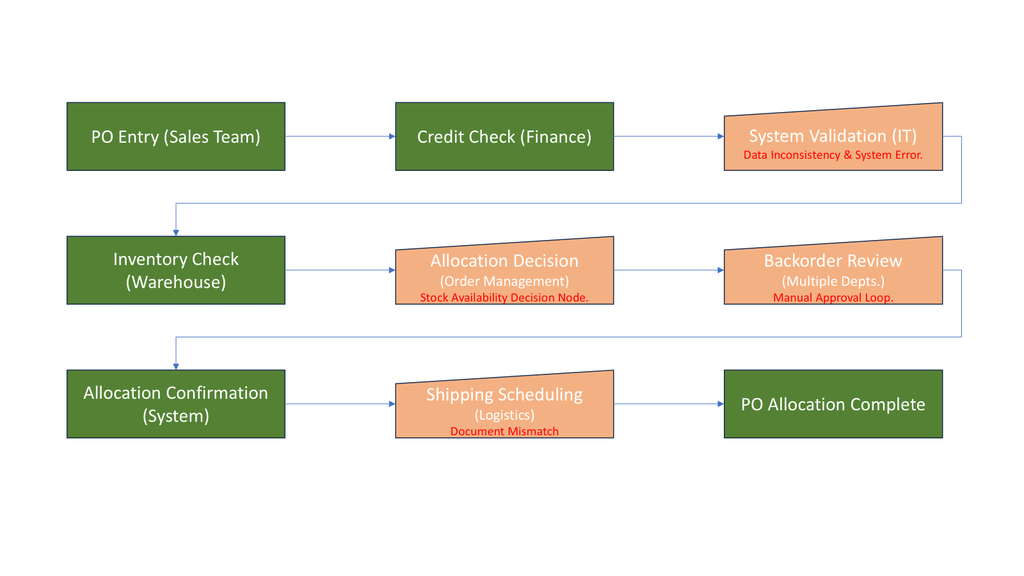
With the workflow and friction clearly mapped, it’s time to have the actual conversation.
For many, this is the hardest part because it requires effort not just from the initiator, but also from other people: other managers, department heads, experts, etc. With people, you never know how things will turn out. While it is a potentially volatile scenario, one must not shy away from it. The only thing you can do is move forward and see what actually happens if you bring this pain point to the other party. With a good conversation that is not directed against them or driven by malicious intent, you might achieve great results and find a common solution that can help eliminate the issues.
Simplicity is the only way
Assuming you took care of the issues currently haunting your team, it is now time to talk about the long haul. One-time improvement is simply not enough. More effort is required to take care of issues for good. Mostly, you achieve this by looking at three simple aspects: ownership, guardrails, and checking.
Ownership is all about who is doing what and when. When you capture this and communicate it clearly with your team, everyone knows where to direct questions or tasks. Of course, a good Team Charter will take care of this for you. It’s always best to invest a bit more at the beginning and have a solid foundation than to try and patch things as they appear.
Guardrails are your basic security measures that you take in order to stop any other junk from creeping in. Don’t be fooled by the fact that one-time improvement will address this issue for you because it will not. You need to establish and implement very tight control mechanisms in your team to make sure this will not happen: better SOPs, better workflows, stronger controls, more workshops with your team, reminders, mailers, and any other type of action you can take to make it work and stop things from re-emerging.
Lastly, the famous check. Many managers fail exactly here, either because they are way too focused on micromanaging everything that they forget to do that part of their job, or because they don’t see it as a necessity. But progress or status checks are an absolute must. Things will get messy again over time, so a quick check here and there will help you stop these issues long before any impact is made.
In the end, don’t let your process fall into chaos just because others have tried and failed, or because no one actually tried before. Accepting the status quo is not a thing anymore. We need to stand up and challenge things to make them better. It’s about making your job easier and having a healthier mental state… or accepting the crazy and staying in pressure, overtime, and general unrest.
Until the next article, stay healthy, happy, and safe!