
How do I survive 30+ hours of weekly meetings?
There comes a time in every new manager’s work life when they realize that every single aspect of their life is now fully captured in the calendar. Customer meetings, feedback sessions, stakeholder connects, monthly business reviews, to-do tasks, urgent tasks, trainings, and who knows what else start to blend together and create this very strange pool of stuff. It’s then when you realize this is your entire week and everything from now on will be done around the calendar.
The truth is, managing this type of existence where 80% of your entire working week is captured in your calendar is not easy to achieve, and for this exact reason, first-time managers have the worst experiences. The single most asked question (I assume) is always: how do I navigate this and properly manage the hectic schedule issue? So, let’s take a stroll down the path of the dreaded calendar and see what you should know and how to better prepare for the inevitable scenario when it will look like the world’s worst thing to look at.
How can I manage a week of work when my calendar has 30+ hours of meetings?
Managing a bloated calendar requires moving from reactive participant to proactive owner by running a daily triage to eliminate fluff, blocking focus time, mastering polite refusals, delegating meetings, replacing status connects with direct emails, and running monthly audits to ensure your schedule stays lean enough for real leadership.
Your Calendar Defense RoadMap:
| STAGE | FOCUS AREA | KEY POINTS |
| The 30-hour trap | Recognizing how back-to-back calendar bloat destroys your actual work output and shifts you from an active manager to a passive observer. | Shift your mindset from a reactive meeting participant to a proactive calendar owner, recognizing that back-to-back blocks ruin output. |
| The Calendar Triage | Categorizing your daily meetings into Must Attend, Optional, and Pure Waste to quickly filter out unnecessary connects. | Categorize every meeting into Must Attend, Optional, or Pure Waste, run a 5-minute morning check at 9 AM, and block focus and lunch time directly in Outlook. |
| The Art of No | Setting clear boundaries by politely declining low-value invitations, asking for your explicit role, and providing constructive alternatives. | Decline low-value invites politely with a clear reason, demand to know your specific role before accepting, and offer async alternatives or delegation. |
| The Art of Ditching the Meeting | Replacing lengthy status-check meetings with brief async updates and coaching your team away from calendar-clogging habits. | Replace 30-minute status-check meetings with quick email or chat updates, and actively coach your team to stop over-booking schedules. |
| The Audit | Periodically reviewing recurring invites and meeting lengths to eliminate obsolete connects and keep your schedule lean. | Run a monthly review to delete obsolete recurring connects and shorten 60-minute meetings down to 20 minutes. |
The 30-hour trap
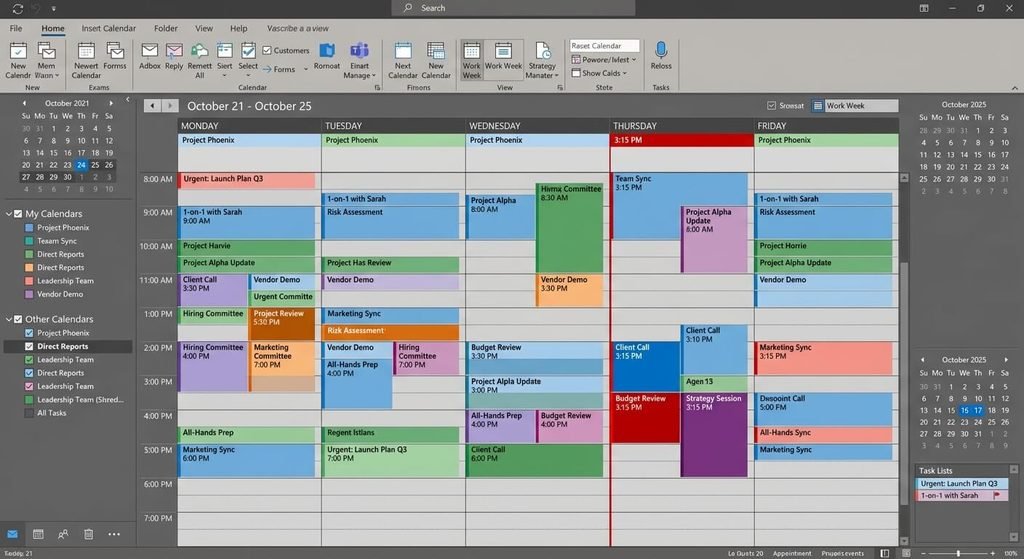
Isn’t that the loveliest thing you have ever seen in your life? Of course it’s not; it’s probably one of the worst. Bloated calendars and the people that keep encouraging this way of working are the worst thing that ever happened to corporate environments since the old school of management.
When your Outlook starts to resemble something like the picture above, one thing is very clear: you no longer own your calendar, it owns you. This means that whatever you need to do is carefully listed in tiny colored boxes with the exact hour and a short text indicating what that task is about. Alongside the mental impact of this realization, we also have the side effect: your entire work week is specifically dictated by the calendar and whatever you need to do must be first checked there. Have a random connect a team member needs right now? No can do, there is no actual time for it. Need a bit of time to think about the next big thing in your team? Oops, no time for that, you have a connect in 5 minutes.
There is also a more discreet aspect of this, and it goes like this: you need to talk to someone about some process (real story by the way), so you go and talk to them; to your surprise, they pull out this notebook, start checking their Outlook, and request you add a 30-minute meeting sometime next week because they just don’t have the time right now to talk to you for 5 minutes. I call this the “Calendar Junkie” syndrome, where people just have this bizarre “feel good” about owning a fully booked calendar. I guess it’s a way to tell other people how busy and important they are. Listen, you are fooling no one with that: the more booked you are as a middle manager when your time should be dedicated to team management and not tons of meetings, the more I think you are full of it and not doing such a good job.
Here’s a strange thought for you: back-to-back meetings are actually killing your work output! Crazy, I know, but it’s actual facts: the more stuff you add to the calendar and try to act like this mega-corporate organized person, the less quality, efficient work output you generate. There’s just no way to leave room for proper impact when all the time you have in a week is going from one connect to another. In part, this is because you are no longer there and thinking about said output; you are more of an observer going from one connect to the next. In this situation, I wish more people would ask this question: When am I supposed to do the actual work if I just hop from one meeting to another?
At one point, a breakthrough must happen in order to break this vicious cycle: it’s that moment when you realize that you should shift from reactive participant to proactive owner. Letting your entire working life be completely encompassed by the calendar is one of the biggest mistakes someone can make, so it’s up to YOU how far you will let this go.
You won’t be able to just cut everything off and go on some crazy no-calendar mentality – that’s falling on the other side. Balance in all things is the only true answer.
The Calendar Triage
Yes, we must talk about it if you wish to master the art of “letting go”. The first thing one needs to do before anything else in this type of scenario is run a quick triage. This means a simple check on whatever you have (usually) to attend and creating a system of classification for those meetings, like:
- Must Attend: These are your must-be-in connects. There’s just no way to skip them. If it helps, think about them as the most valuable connects, usually the ones that are either with important customer updates that you must be personally aware of, connects where only you are able to talk about a specific topic, or any other must-be type of situation.
- Optional: These are the “am I really needed there” type of connects. Some might be complete fluff and just create waste; some might be important, but you could just grab the minutes or the (more recent) AI transcript, since everyone is recording them with AI.
- Pure Waste: These are the ones you need to remove 100% from your schedule. If a meeting is not bringing any kind of value, just remove it. Examples include but are not limited to: connects where people review slides or read things, connects just to connect and talk about nothing of actual importance, any meeting that can actually be removed just by sending an email, etc.
A sad effect post-COVID was this obsessive need to have a lot of meetings, either to justify work or using the now famous quote, “it’s faster if we connect”. The reality is this: it’s not faster if we connect most times, because meetings tend to go off-road, add more waste, and even cause agitation or stress. If you can send the information in an email, just do it.
Another aspect you should consider is delegation. I have an entire article about it here: Delegating Tasks: Unlearn Individual Contributor Habits. Sometimes it happens that first-time managers (or more experienced but micromanaging-type leaders) get so caught up in things that no actual time is left (hence something like the Outlook crowded image I shared above). Don’t be like that: if you have people on your team who have the potential, invest in them and get them involved in other aspects – while also making a bit of room for you in that busy calendar.
An equally efficient way of doing a triage – say, something you can do after your meeting verification – is the 5-minute check at 9 AM (or whenever you start your day). Most times, our day is already full of things to do way before the start of your schedule, so it’s only reasonable to say that you know early morning what your day will look like. A simple check on all the connects you have for the day can really improve the quality of your day and remove any fluff meetings you might have. Just look at them and ask the dreaded question: Do I need to be in this meeting?
My personal best is the reverse psychology attack on busy calendars: when I need time to focus, I block that part of my day directly in Outlook. This way I make sure no other meetings are added; if they are, I just click decline, since the time is already blocked. I started doing this during the pandemic as a way to protect my lunch, as a lot of people were adding meetings all the time, at any hour, and I was starting to skip my lunch. Not acceptable in any way, as that is something personal and health-related – also, no food when I need it makes for a cranky day. Not recommended!
The Art of No
I know, it sounds like a LinkedIn post, but it’s really that simple: you have to start saying no to things. In the corporate environment, there’s so much diversity of cultures and people that it’s impossible to keep good track of everyone you interact with, what they like, don’t like, etc. Because of this, people just gave up any sense of normality (like we had before 2020) when meetings had to be set up after checking availability: now it’s meeting here and meeting there. This is the perfect ground for the magic word we all must learn: NO.
There is, of course, an art to it, because one must have grace and say No in such a way that will not be interpreted as a hard reject or, worse, jerkish. It’s important to note that any decline or refusal must come with the appropriate reason: please note I am attending another connect and I am not able to join; please reach out to my SME for this meeting and they should be included, not me; please note I am busy during that timeframe and I can’t make it, etc. Note the excessive use of please – we must say please after a No; it sounds less bad, trust me.
In addition to the famous No, there’s also something else you need to start asking of people: what is my specific role here? If you just accept meetings and join them without even inquiring about it, then you are as responsible for the waste. Start pushing the correct procedure: teach people that when they interact with you, they need to explain the reasons why you are included, more clearly the exact role you play in the meeting. If you are just there for body count, then refuse… really no point in it.
Offering people alternatives is also a good way to say no without sounding like a big jerk. Either directing them to other, more relevant people, or by suggesting other timeframes, or just asking them to send whatever information they need from you in an email so you can reply in your own time. It’s about the way you sell the no that ultimately makes a difference.
Just saying No is no longer in!
The Art of Ditching the Meeting
Yes, this is also one of the solutions for your issue with the crowded calendar. Start ditching these crazy 30-minute meetings for status checks for a much more efficient way: send it in via chat or in an email. Why waste 30 minutes of your life listening to 6 people just doing a status check, when each of those 6 people can spend at best 5 minutes writing an email and sending it to whoever is responsible? That’s 2.5 hours total saved from a 30-minute connect with 6 people.
It might also happen that the team you have inherited is already very accustomed to working with the “put everything in your calendar” mentality, in which case you must correct it and coach them on the new terms (or your terms). It’s more work, yes, but at the end of the day, there should be an expected level of such behavior – not from them personally, but from whoever managed the team before. As the leader, it’s your job to make sure everything is on the table and people understand what is needed. Talk and explain why having a fully booked calendar is not a measure of “working hard”, but more of “inefficient work”.
And on this topic, remember that people must be reminded about clogging schedules. Some need this reminder multiple times, so make sure you do it until it’s crystal clear and becomes the norm.
The Audit
In the end, one last thing you should do for a nice and clean calendar: audit every month the calendar and check what meetings you are keeping and what meetings you are skipping. Start with the recurring ones and ask: are they still needed? Should we keep this connect each month (for example), or can we just take care of it now and remove it? Obsolete connects must go, NOW! Don’t keep them; remove them and move on.
Another aspect of your audit should be the duration of the meetings, with the appropriate question attached: do you really need 60 minutes, or can you do the connect in 20 minutes? If the answer is yes, then do it. Why spend so much time when a simple restructure can take care of the issue faster? It will also help the people involved, as they will get exposed to a better way of participation: no more long meetings talking about everything – now it’s about the fast, clean, and simple direction. Nothing less, nothing more.
And the final reminder: keep your schedule lean. You need time to focus on other things. As a people manager, you are expected to be there for the team, help them, and coach them. How can you do this if your entire calendar is booked? If you end up in this situation where you can no longer talk to your people because of a back-to-back schedule in Outlook, I hate to say it, but you are no longer doing the job you are supposed to be doing.
Until the next article, stay safe, happy, and healthy!