
How do I track all my own deliverables without losing focus?
One of the least talked about and probably last to be considered aspects for first-time managers (or people looking into transitioning to the role) is the personal organization system: people just don’t give it too much attention because they just assume whatever they did before, as individual contributors, will be more or less the same now, as people managers. This, however, is not how things are in reality, and most people in this situation realize the truth a bit too late. By the time a new manager has a proper understanding of how important it is to have a good system for daily tasks, some of the starter damage is already done.
Starter damage is my personal description of fundamental or core leadership skills that are not taken into consideration, creating false perspectives or incorrect ways of working in the mind of the first-time manager. Think about all those people working extra hours, spending time after hours on their laptops trying to execute tasks they should have done during working hours, people with 1,500 emails in their inbox, those with desks filled with sticky notes and other pieces of paper, missed deadlines, and meetings popping up all over the place. Each time I talk to them and ask how they can work like this, I always get this answer: “I am perfectly fine like this, I work better this way actually because I know exactly what I need to do.” But it’s really not fine; this type of work habit is more damaging than you could ever imagine.
How can I learn proper task organizational skills?
Transitioning from an individual contributor to a people manager requires adopting a structured personal task organization system – such as Kanban boards, daily prioritization routines, capture systems, and delegation tracking – to prevent the overwhelming chaos, missed deadlines, high stress, and long-term team burnout caused by carrying over unstructured habits into leadership responsibilities.
Your Organizational Skills Roadmap:
| STAGE | FOCUS AREA | KEY POINTS |
| The Chaos Theory and the Long-Term Impact | Compares messy work to Six Sigma defect opportunities and outlines the immediate and long-term risks of chaotic workflows on stress, trust, and team performance. | Eliminate messy work habits immediately to lower your operational error rates, reduce personal stress, and prevent team burnout. |
| The Kanban Way of Working | Details how to adapt Lean manufacturing principles and Toyota’s signboard system into a four-column Excel task board. | Create a basic four-column task board (Backlog, Active Focus, Waiting On, Done) in Excel to limit work-in-progress and visually track your deliverables. |
| The Daily Prioritizing Routine | Breaks down daily workload management into capturing/filtering tasks, setting non-negotiables, and protecting focus time. | Start each day by capturing/filtering tasks, locking in your absolute non-negotiables, and scheduling dedicated focus time on your calendar. |
| The Capture System | Explains simple methods for tracking to-do items – such as status columns or crossing off completed tasks – while warning against over-complicated color coding. | Choose one simple, low-color method – like a status column or crossing off items – to record every task, and review your notes daily during short breaks. |
| The Delegated Deliverables | Emphasizes that delegation requires active tracking and follow-up via a “Waiting On” list rather than just assigning work. | Build a “Waiting On” tracker for assigned tasks and use 1-on-1s to regularly follow up with team members without micromanaging them. |
| The HABIT | Focuses on the behavioral consistency, routine cleanup, and aggressive simplification required to keep any task organization system effective over time. | Clean up your trackers on a daily or weekly basis, purge unnecessary administrative noise, and maintain the personal discipline needed to keep the system running. |
The Chaos Theory and the Long-Term Impact

If you are familiar with my work here, you probably know about these two topics: Delegating Tasks: Unlearn Individual Contributor Habits and Doing Everything Myself: From Doer to Enabler. In them, I talk about how different shifting from “Doer” to “Enabler” is, and touch upon the differences between the Individual Contributor way of working compared to the People Manager. A core aspect from this point of view is the way people relate to (and understand) the importance of proper task organization, with many first-time managers being trapped in this complete chaos where everything is happening all at once.
Preparing for the new role is not just about how you communicate with people or how well you are familiar with processes and clients, but also about how YOU do your work. Think about it as a cooking experience: how does a very messy cook look compared to a much more organized and clean one? When you are dealing with a messy way of working, most of the time it is very hard not to commit any mistakes (miss deadlines, read emails “diagonally,” skip important meetings, etc.); in Six Sigma, we call this a situation with a higher opportunity for errors, because the messier things are, the more likely you are to make mistakes.
On the other side, anything that you keep repeating becomes a habit. Once the chaotic way of working is mentally established as normal and part of who you are, you should expect the appropriate cause-and-effect impact. Both short- and long-term impacts can have some really nasty effects.
Short-Term Impact:
- Missed Deadlines & Escalations: Dropping the ball on key operational tasks, like approving leave or submitting team metrics on time.
- Constant Firefighting: Spending the day reacting to small emergencies instead of focusing on high-value priority work.
- Team Confusion: Failing to communicate priorities clearly, leading to agents working on the wrong tasks or duplicating effort.
- Loss of Personal Credibility: Looking unprepared in meetings or failing to follow through on promises made to team members and upper management.
- Elevated Stress: Experiencing immediate overwhelm and anxiety from feeling like work is constantly slipping through the cracks.
Long-Term Impact:
- Burnout & Turnover: Chronic disorganization leads to long hours and constant stress, eventually causing the manager or demoralized team members to quit.
- Eroded Team Trust: Direct reports stop relying on a leader who constantly forgets 1-on-1s, delays feedback, or blocks their progress.
- Stagnated Career Growth: Upper leadership notices the inability to handle basic operational mechanics, blocking opportunities for promotion.
- Low Team Productivity & Quality: Unorganized workflows lead to higher error rates, missed service level agreements (SLAs), and poor customer satisfaction scores over time.
- Micromanagement Traps: Disorganized managers often resort to micromanagement at the last minute out of panic because they failed to track deliverables properly from the start.
When you step into the shoes of the people manager, something interesting happens: your time is no longer just yours. I know, it sounds crazy, but it’s the reality; everything you do is no longer just about you – it’s about the people, the processes, the increased responsibilities, and higher-complexity tasks. Because of this, every action you take must have the following thought in the background: how will this impact my team?
Another thing you need to keep in mind is constant firefighting: when you have to deal with a lot of fixing, the last thing you need is a messy style of work. The messier you are, the more chaos you invite in and the more firefighting you end up doing. It’s a crazy, endless loop of chaos and fixing. The only way to break the wheel is by destroying it (the Mother of Dragons would be so proud right now).
The Kanban Way of Working
Now that we have talked about the theory and why an unstructured and messy style of work is bad, let’s focus on how we can fix it. There are many ways of approaching this topic, but all of them have one thing in common: structure.
A very balanced (and visually pleasing) way is to create a Kanban task board. Kanban is a Japanese word that basically translates to signboard, and it is an essential Lean tool used in manufacturing. Taiichi Ohno, an industrial engineer at Toyota, developed Kanban to improve manufacturing efficiency. The system takes its name from the cards that track production within a factory. Kanban is also known as the Toyota nameplate system in the automotive industry. A goal of the Kanban system is to limit the buildup of excess inventory at any point in production. Limits on the number of items waiting at supply points are established and then reduced as inefficiencies are identified and removed. Whenever a limit is exceeded, this points to an inefficiency that should be addressed.
In the reality of the first-time manager dealing with basic operational tasks, this system is perfect for structured, easy-to-follow, and effective workload management. Think about all the tasks you must complete, and imagine how hard it is to keep good track of all of them (deadlines, updates, marking them as complete, assessing priority, etc.). You can create one in Excel with just a few simple steps:
- List all the tasks you must complete.
- Now create a series of categories; I used four: Backlog, Active Focus, Waiting On, and Done.
- Now place each task in its own category.
The end result, after some minor visual updates, should look like this:

You can customize this however you want; the main idea is to have a proper structure for whatever tasks you need to complete, to follow it, and to make sure it is updated in real time. Make this your personal book of work, the go-to place for every possible task.
The Daily Prioritizing Routine
Another equally efficient way of achieving proper task management is a daily prioritizing routine. Sounds fancy, right? It’s really not. The basic idea is very simple and easy to implement. We start with the same core principle of listing all the tasks you need to do on a specific day or week (or whatever other frequency you want to set).
Now we need to create the routine, and for this, we must establish three major segments:
- Capture and Filter: This will be the first thing you do as soon as you start work.
- Establish the Non-Negotiables: These are the absolute must-do tasks that you have to complete regardless of the situation. And don’t be fooled into thinking that you can push back on some of them if other tasks come up later. Stick to the plan and let nothing stand in your way.
- Protect Your Focus Time: It might sound strange, but leaders need time to focus on whatever they must deliver. While people management will require you to be available for all sorts of issues, as a human, if you want to keep efficiency high and your mental health intact, start protecting the focus time you need to catch up on things, research, create, etc.
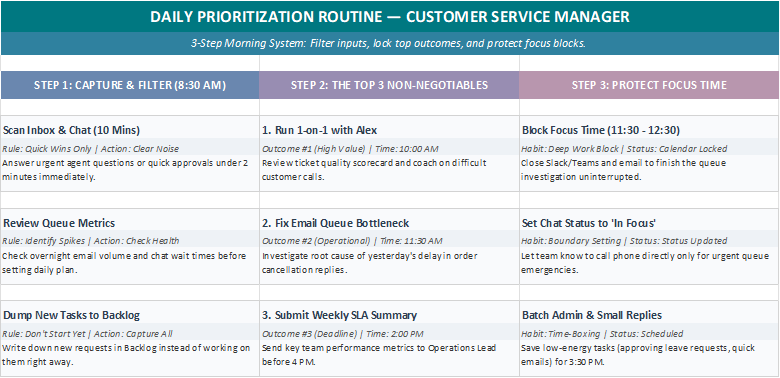
The idea behind this is for you to have a clear, structured, and efficient routine that will get you through the day. It will serve both yourself and your team, as we are creatures of habit – once people get familiar with your way of working, things become much easier for everyone.
The Capture System
In some previous posts, I talked about my own preference when it comes to task management, so I will present this option here. It’s a basic capture type of system where you list out the tasks you need to do and decide on a specific way of tracking completion.
One option is to just have all the tasks listed, with a column next to them for “Status,” where you can add an “X” for the ones that have been completed so far. If you want to go the extra mile, you can arrange them by priority, impact, or importance, or you can use a color-coding system. I don’t really like an excess of color because we tend to overdo it, ending up with ridiculous Excel files using 10 colors that no one can understand anymore. Less is more in this case.

Another option is listing the tasks and crossing them out once done. This one is my favorite – it’s something I learned a long time ago from a mentor. She told me to do this specifically because as you cross items off, you get a genuine feeling of accomplishment, even more so if you have them written down in an agenda.

Whatever system you decide to use, the main idea is to stick with it. Take proper notes, add observations where needed, keep a single document or notebook close to you at all times, and be thorough in everything you write down – especially details like dates, times, people to contact, and relevant context.
Make sure you review these notes as often as you can during the day. You can always take a 5-minute break from everything to review and extract appropriate insights from them. For example, when I need focus moments to review notes and think about next steps, I find music to be a great stimulus: just pop the headphones on, blast whatever tune you need, and get going.
The Delegated Deliverables
A core aspect of leadership is your ability to delegate, and while the basic idea is understood by most people, not everyone gets that delegation is not just about telling someone to do a task – it’s also about tracking it. You see, it’s not enough to just say, “John, please do this report for that customer by the end of the week.” You also have to follow up with John, ask if he needs help with it, check if the deadline is still realistic, and so on. A clear indicator of poor leadership is when you receive a task from your boss and that’s it – nothing more, nothing less. No follow-ups, no questions, nothing. If you ever do this, you need to understand the negative impact it has:
- Dilution of Delegation: Delegation is not about lessening your workload; it’s about giving other people on your team the opportunity to learn and grow.
- Low Engagement: What’s the point of asking someone to do something if you aren’t interested in the outcome? It becomes just another directive with no relevance, creating the perfect environment for disengagement and disappointment.
Another important point is to maintain a solid “Waiting On” list – a tracker in your files for all these delegated tasks that other people are responsible for. Just create a basic Excel tracker with the Task Name, Responsible Person, Deadline, Status, and whatever else you might need. Check this as often as necessary, and follow up when required.
Having this delegation tracking system will also allow you to close the loop on tasks during your 1-on-1s without resorting to micromanagement. By now, you know how much I dislike micromanagement and its impact on people. Task tracking is a great way to check on progress without being overbearing.
The HABIT
Now that you have an idea of what task management looks like, let’s talk about behavior. You can have all the training and tools in the world at your feet, but without personal investment and behavior change, nothing will actually matter.
In my experience over the years, I have seen some absolute nonsense scenarios where people had complex schedules, calendars booked solid from 9 AM to 6 PM, agendas filled with pages of to-do lists, and all sorts of other tools – yet they weren’t consistent. If the desire for change and improvement isn’t there, nothing you set up brings value. You can have 5 agendas and 50 trackers; it won’t matter.
Make it a habit to clean up your boards and trackers daily or weekly. If you leave them messy, you return to the classic situation where you have 1,500 unread emails sitting in Outlook.
Finally, know when to simplify things. I follow a rule in life, not just at work: when things get too crazy and chaotic, it’s time to cut back and simplify. I find this to be a much better coping mechanism than trying to organize more, make more plans, or build more structure. Just cut through the noise and make things simple – the less noise you have, the better your outcomes will be.
Until the next article, stay safe, healthy, and happy!