
How do I listen so people feel truly heard and understood?
Have you ever had a conversation with your manager and felt like something was off? Like they were not really there for you, and whatever you were saying, they were just not listening? What about situations where regardless of how much you explained something, the other side just didn’t seem to get it?
Unfortunately, this is one of those gray areas in management that focuses more on art rather than data. Truth be told, management is a combination of art and science. It’s not just about following a framework or being driven by pure numbers; it’s about the human aspect. And each time we have humans in the equation, things tend to be less simple.
So, what is the secret to good listening in leadership?
To truly master active listening as a manager, you must deliberately hold back your immediate urge to solve every problem, tuning into non-verbal emotional cues and what remains unsaid. By mirroring their thoughts back and validating their feelings without defensiveness or dismissal while remaining fully present, distraction-free, and comfortable with quiet pauses you transform routine check-ins into safe spaces where your team feels deeply understood and genuinely supported.
Your basic first-time manager roadmap for proper listening:
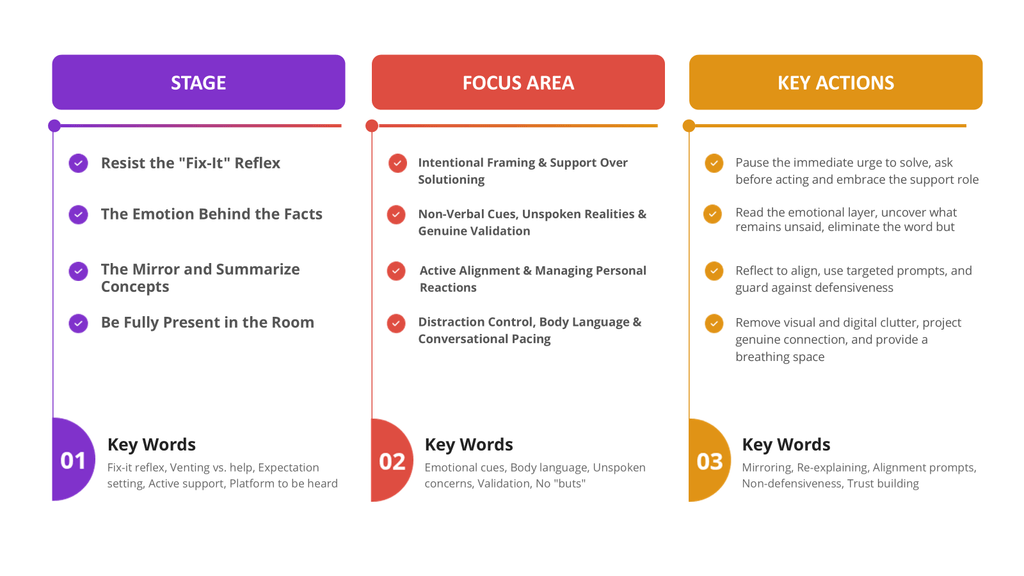
Resist the “Fix-It” Reflex
A core mistake for many managers, both less and more experienced alike, is this crazy reflex to jump in and start fixing things even when they don don’t actually need to be fixed. Sometimes people just need a time and place to be heard. There’s really no need to go above and beyond to try and fix something when that’s not what they need from you. In addition, trying to immediately remedy a situation while you might think it’s a great way of showing you are there for that person can at times indicate that you just want to patch things up and move on.
Because of the human aspect, it’s always good to just ask people if they need a moment to vent and be heard, or if they actually need your help before you do anything. It’s a good practice because you set the proper context for the meeting beforehand and clarify expectations right at the start.
Leaders tend to react based on their environment, thinking that the responsibility of people management means trying to help every single time. While most times this might be true, it’s not a universal rule. Reacting immediately to repair a situation or solve some unique case can create the impression that your focus is on a “check, repair, and move on” approach. This is not the image you want to cultivate; your focus should be on support, and sometimes that comes down to just being there and listening.
From time to time, I’ll have at least one person on my team who needs to vent every now and again. They are not looking for anything specific, nor an action plan; they just want a platform to be heard. Sometimes we might even discuss potential perspectives on the issue at hand or debate it, but the basic idea remains simple: be there, listen, and ask what they need.
The EMOTION Behind the Facts
It’s hard, especially for a first-time manager, to grasp this concept, but the reality is simple: part of a conversation isn’t made up of words, but of emotions. The way people smile, laugh, raise their eyebrows, grimace, or look at you – body language, gestures, and tone – all make up a conversation. Picture trying to communicate a very difficult situation to someone: you do it by adapting an appropriate posture, gestures, tone, and facial expression. You wouldn’t tell someone they are losing their job while smiling; that’s just crazy. It’s the exact same concept with the emotion behind the facts.
The first layer people usually look for is changes in tone, energy, and body language. These tell you a lot about how a conversation is going. If you look closely, you can catch these small changes and assess how well or poorly the conversation is progressing. It takes effort, and it has nothing to do with the data-driven approach we usually see in management. It’s the art part, and you can leverage this to your advantage to ensure the people talking to you feel comfortable.
Sometimes it helps to look at what is left unsaid rather than just the context of the conversation. It sounds strange, I know, but people tend to hide a lot of aspects for different reasons: retaliation, fear of authority, shame, etc. When you have a conversation, try to gently draw out the points that aren’t being explicitly said – let them come from you – and see how the person reacts.
A big mistake made all the time by managers, especially new ones, is the famous “I understand you, but…” phrase. I heard an old saying that goes something like, “anything before the word but means nothing.” Human interaction is based on a similar principle. When people come to you with a situation, it’s not just the factual issue happening; it’s also the experience that person is going through.
This is why it’s of absolute relevance to validate them and make people aware that you relate to and understand what they are experiencing. You can share something similar to let them know you’ve gone through it too, or you can simply say you are trying to understand. Leave “but” aside, just say you understand. There’s no point in saying, “I understand you, but what you are feeling is wrong.” At the end of the day, a feeling is a feeling, and regardless of what you say or do, it won’t just vanish. Sometimes, by trying to combat those feelings instead of supporting the person, you make things worse.
The MIRROR and Summarize Concepts
Not many people do this, but great leaders do. Mirroring is all about reflecting back on the conversation and re-explaining it to the other person in your own words. You are aiming for alignment, a confirmation that you heard and understood perfectly what they are trying to tell you. This accomplishes two important things: it filters the experience through your own mind and lets the other person know you were actually listening.
It helps to ask questions that highlight these feelings, for example:
- “It sounds like you are overwhelmed by the volume of work, is that right?”
- “So, if I’m tracking right, the main friction point here is…”
- “It sounds like the biggest blocker on your end is…”
- “What I’m taking away from this is…”
- “It feels like you’re carrying a lot of the weight on this project, is that fair?”
- “Sounds like that decision caught you off guard.”
- “I get the impression you’re feeling a bit stuck on which way to go next.”
Don’t get defensive. Sometimes people will react in a less-than-ideal manner, so try to keep your cool. People often just need the room to make sure they are understood and heard.
I remember a moment many years back when I needed to vent to my boss about financial aspects of my job, and they got very defensive and acted like it was a major betrayal. That is not the right response. It made me feel angry, unheard, and misunderstood, and my confidence in that leader took a major hit. How could I trust them again when bringing my worries and concerns was met with that reaction?
Be Fully Present in the Room
This one might appear easy, but it’s really not. Managers often assume others aren’t fully aware of how they act or what they are projecting, but this is a massive oversight. Remember, you work with your team all the time, so they know you: they know how you act, how you react, and what your tone and body language are saying at any given moment.
Being present starts with eliminating anything that might cause a distraction: close all browser tabs, mute notifications, put your phone away, etc. Personally, during 1-on-1s, unless I genuinely need my laptop to review something with the other person, I stick to these rules:
- I bring only my agenda (I’m old school, writing things down helps me more than keeping them in a virtual space).
- My phone is always on MUTE and face down so I can’t see the screen.
- I maintain direct, open eye contact.
- I keep an open posture and use a calm, caring tone.
Relaxed, natural eye contact helps you connect far better with the other person, painting a clear picture that you are actually present and listening, not multitasking in your head or thinking about what you’re going to eat in a few hours.
Giving a bit of “breathing space” after someone finishes speaking is a great way to let them know they aren’t being rushed or pushed out. Give them time to gather their thoughts or formulate what they want to say next. You don’t have to fill every single second of silence in the conversation.
Check out more details about these topics in these two articles: The First-Time Manager Starter Pack: Days 1–30 and Your First 1-on-1: How, When, Why, and What.
Until next time, stay healthy, happy, and safe!