
What decisions can I make without asking for permission?

Well look at you! All comfy and enjoying the role, while your spirit glides over this recent achievement.
But not all is pretty and pink, is it?
With the new job comes a big question, and one that will separate the leaders from the “managers”: where does my authority start and end, and what decisions can I make on my own?
It’s a very common dilemma for the new manager. While some basics about the job have been explained, not many hiring managers go over the exact extent of authority. Usually, you just get a big pat on the back and something along the lines of “well, they are your problem now, pal”. With this comes a lot of anxiety and confusion for the first-time manager, because they don’t know where to start and where to end from this point of view. At what point do I make decisions on my own, and when do I ask for higher approval?
Because of this, a lot of first-timers find themselves in very delicate waters: some have bosses that will micromanage every aspect of the leader (making them in essence just an extension of their own will), while others are left to find solutions for themselves or, worse, get stuck with the stigma of “well, didn’t I hire you to find solutions and not come to me for every little detail?”.
All of this in turn, sometimes, creates a bad situation: the newcomer is left in a limbo with unclear expectations and loads of internal struggles they don’t know how to handle. In today’s article, we will talk about all of this and help you with a simple yet efficient guide on authority and proper decision-making as a first-time manager:
- Don’t ask for permission at every possible step
- The Decision Zone map
- Your dollar limit
- The approval chain
- Document those decision boundaries
Don’t ask for permission at every possible step
Here’s the thing, friend: while you are new and want to impress, showing the upper bosses you are the best decision they made by going to them with the false “let me consult with you on this topic” narrative can actually cause more harm, for both you and the team. Some of these upper management people have a lot of issues on their plate, and honestly, they don’t need you to come and ask about every single detail out there. While in an ideal world you would benefit from constant support and hand-holding for most aspects, reality will hit differently: there’s just no time for this, and in a way, you should be thankful.
As a leader, you are now put in a special position: based on your “gut feeling”, proper data-driven decision-making, and solid business logic, you can make some of these decisions on your own, and it is highly recommended to do so. Showing your bosses (but more importantly, your team) that you can manage taking charge of different situations without constantly asking for approval will cement their trust in you. It’s a sure way of asserting both your expertise and your authority. What’s the point in them coming to you anyway if you can’t help them out?
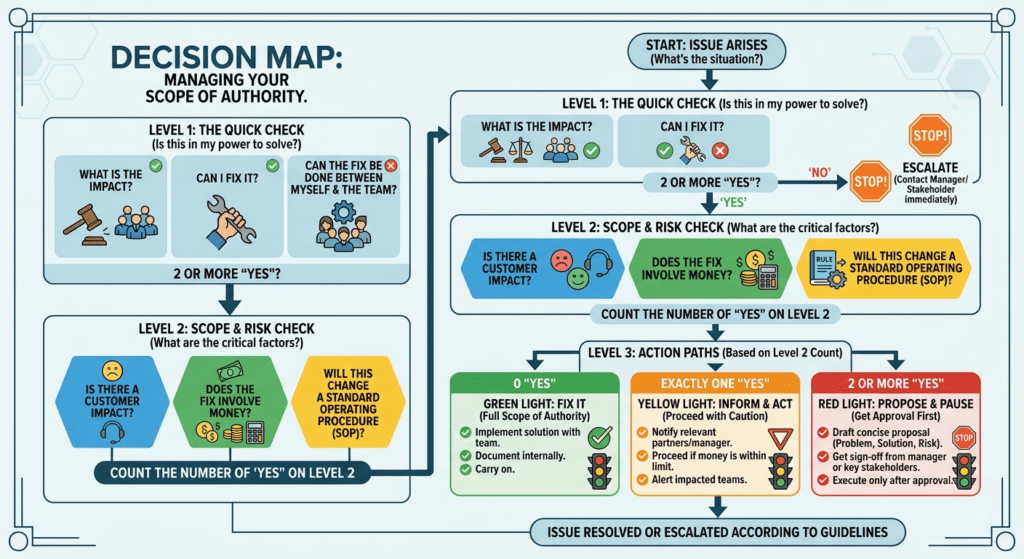
To get you on the road to glory, let’s start with the basics. When you have an issue, you need to fast-check a few things before any action is taken.
Level I – Quick Check
- What is the impact?
- Can I fix it?
- Can the fix be done between myself and the team?
If you have at least 2 “Yes”, you proceed with the next level. If you have at least 2 “No”, STOP and escalate. You don’t want things to get crazy.
Level II – Scope and Risk
- Is there a customer impact?
- Does the fix involve money?
- Will this change any fundamental ways of working or standard operating procedures?
If you have 0 “Yes”, you are good to go and can immediately do it. If you have 1 “Yes”, you inform and act (relevant partners, check your budget limits, etc.), and if you have at least 2 “Yes”, you STOP, create a proposal, and send it for higher-management review.
Here’s a visual layout of this, if it helps.
The Decision Zone map
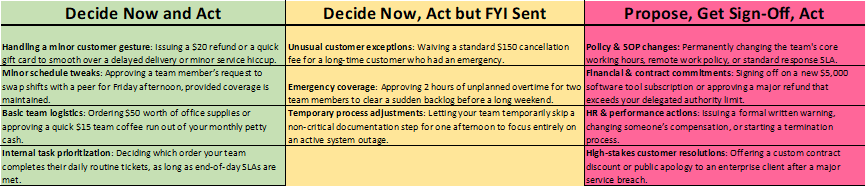
When we talk about making decisions that fall under our scope, the best thing we can do at times (even more for the first-timers doing this) is to map out some kind of decision zone map. The principle of it is very simple: you list all the things you must do from an authority perspective and try to categorize them into 3 different zones: green, yellow, and red.
- Green: Decide Now and Act. These are low-risk, day-to-day activities where you can make a decision without having to worry about major impact or any potentially problematic areas.
- Yellow: Decide Now, Act, but FYI Sent. You can make decisions here without any issues; however, your manager should always stay informed about them, thus the “For Your Information”.
- Red: Propose, Get Sign-Off, Act. These are the ones with significant changes, budget approval, structural changes, etc. You need to propose it first, wait for sign-off, and only after that do you act.
A great way to map them out would be by using an Excel file. Let’s take an example for a Customer Service Manager: every new manager interacts with customers, handles small operational hiccups, and manages team schedules.
Your dollar limit
One of the more delicate areas of management, especially for the first-time manager, is the budget. Finding out when your authority starts and when it ends is essential. This is something you must clarify with your HR business partner and direct manager before anything else. Many companies have strict policies from this point of view, so you need to be very careful here and make sure you have all the information you need before doing anything. Don’t take action unless you saw the procedure or have written consent from the right person.
Since it’s a topic of precise and accurate information, it’s only natural you find a way to capture this and make your life easier. Depending on the company, you might have different ways of working from this point of view, and if you find yourself struggling with too many of these budget issues, here are some steps to make it easier for you:
- Approve without sign-off: Check everything that goes into this category, like expense reporting, software purchases, office supplies, etc. These are the things that you have direct power over and can be approved on the spot. Best pro tip I can give you here is: keep all of these, even if you are not required to, in a tracker file with the date, quantity, price, etc. You might need them at some point.
- Check your team perks, bonuses, and/or emergency spending rules: Make sure you capture these and have a proper document that highlights how, what, and when to do them. Be very mindful about them because too much spending is not a good sign of management. While investing in your employees is the main focus area, make sure you don’t go crazy with bonuses, team perks, or emergency spendings because there is always some finance manager watching who is there to monitor spendings. If they are out of balance, you risk future penalties for you and your team, like spending cuts, unnecessary sign-offs for other people, business cases, and a full stop on all spendings (in severe cases). Too much or too little of anything is always bad, so you must keep a balance between them. If you have the money, spend it, but don’t go over the limits.
- Track every little budget spent you can: This is the best strategy because everything you track can be looked at and assessed. You don’t want spendings to be a surprise at the end of the quarter. Sometimes companies have really strict rules, and if you are over budget, you might even get news of headcount reduction because there is no more budget – you spent it all. This is why what you do today matters a lot tomorrow. Now that you are the leader, it’s your job to track and take care not to transform things into quarter-end bad news.
The approval chain
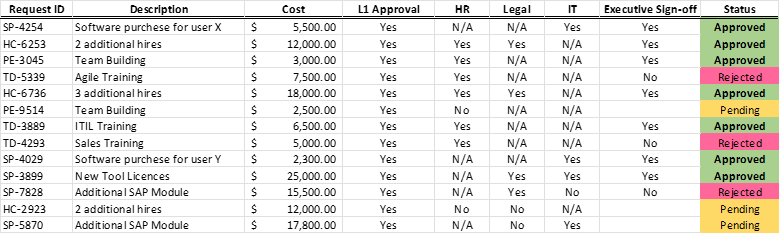
Every company has one. It’s embedded into the core, and something not very easy to trick. Any changes you make, financial or otherwise, have a specific approval flow to them. While some have very simple and basic flows, others are more complex and bureaucratic. As a general rule, the bigger the company, the worse the approval chain goes. This is because big companies need more checkpoints and have to be more vigilant when it comes to spendings. Smaller companies have an easier process, mainly because you don’t have so many people to look at and/or check.
This chain is something you need to understand from the start. Sometimes it won’t be very easy to get the info, like a big overall “all approval chains” type – they might be scattered all over the place, making documentation a bit difficult. But that should not deter you, because there is always something you can do about it. A very simple yet efficient way to go about it is to have an approval chain file that you fill in; this way, you have both a good track of whatever it was you approved and also who is approving.
Document those decision boundaries
And as always, when it comes to leadership for the beginner, the magic word is: document, document, document. Everything you must do, all the things you need to keep in mind, procedures, and steps. I know it sounds like a lot, but having good, reliable documentation is a sure way to always go back and check them. You don’t need to remember by heart absolutely every little detail; this is why when things are written down, life is much better.
These decision boundaries are very flexible, and in time they will change: politics, a new CEO, different economic factors, etc. It’s important to always go back and look at them and see what has changed. You are at the front of them, so be prepared.
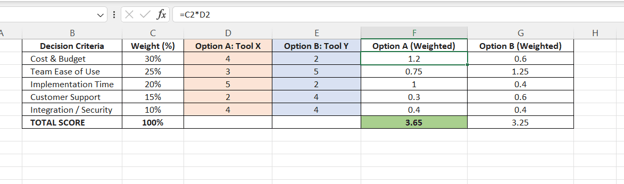
In case you might be struggling with decision-making for different aspects, here is my template (with made-up data, of course). I use a criteria blend of cost, team accessibility, implementation time, support, and integration. Using a team of either subject matter experts or people with hands-on experience, we assess each option on a scale of 1–5 for all decision criteria points. A weight system is assigned to each (this will depend on your process, of course), and then it’s a matter of multiplication: individual decision criteria option * weight. The option with the biggest total score wins.

Until the next article, stay healthy, happy, and safe!