
How can I give effective feedback as a new manager?
With the new job comes all these new and interesting responsibilities and pressure from clients, upper management, and your team, and it’s no wonder you feel a bit lost. This is perfectly normal! Giving feedback, while one of the most common aspects of management, falls under the more complex tasks. This is in part due to the human nature aspect, as feedback is provided to another person and not ChatGPT. One of the biggest mistakes first-time managers make when it comes to this topic is waiting for the performance review. If you wait months to discuss something, a great many things will go wrong. Remember, in management, the more we ignore something, the worse it gets. So, if you feel the need or think that giving feedback should be done at the end of the year (or whenever your company has the annual performance review): DON’T!
How should a first-time manager provide effective feedback?
To maximize performance and prevent defensive threat responses, first-time managers should deliver continuous, task-focused feedback rather than waiting for annual reviews. By framing issues around specific behaviors, offering dedicated support, and using actionable, forward-looking strategies tailored to the audience, leaders can effectively navigate downward, peer, and upward communication to drive growth and build trust across all team dynamics.
Your first-time manager effective feedback RoadMap:
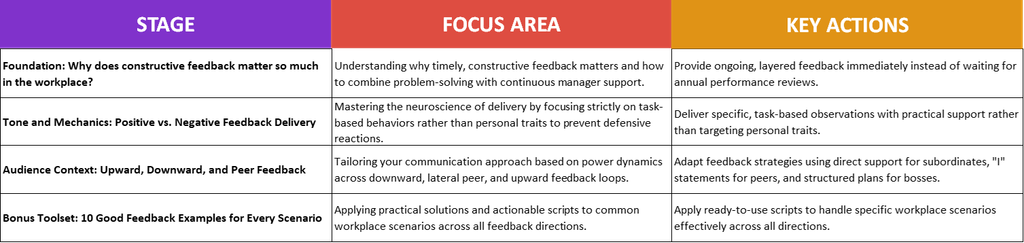
Foundation: Why does constructive feedback matter so much in the workplace?
This is a topic we talk a lot about, especially on social media. Everywhere you look, you have at least one discussion about how feedback should be done in a constructive manner, how important it is, and how people are still learning how to do it. So, let’s look at the current reality before going into specifics on why. Latest research shows some pretty terrible numbers on this topic:
- Only 14.5% of managers strongly agree they are good at giving feedback, according to research by Gallup.
- 9 out of 10 managers (90%) fail to give enough constructive feedback, according to a Leadership IQ study of over 30,000 employees.
This aligns perfectly with my 20 years of experience. Honestly, some managers are really bad at giving feedback. Most of the time it’s biased, it’s negative (and as such, the entire feedback is associated by the employee as a negative experience), and it adds pressure and inhibits growth and harmony. My guess is that this is tied to the way these managers are trained and coached. Because most people, when promoted, are just “dumped” on the job and expected to deliver, they react the best way they can.
New managers tend to navigate the topic of feedback by using a blend of personality and experience, meaning they do it based on what they experienced in the past and on how their own personality works. This is not always the right way. Sure, some may have a “built-in” system that allows for good, constructive feedback; however, the vast majority just don’t know how to deliver it.
Feedback must be constructive. This means that whatever you plan on discussing with your team member must be done in a layered approach: on one side you have the issue you want to address, and on the other side, you will have the support you are providing to help them. Constructive feedback also means talking about a pain area without making the other person feel like the biggest loser in history. Words, tone, and reaction also matter, a LOT.
For example: instead of telling a person they should never submit a payment without approval or else they will face severe consequences, try a more constructive approach:
- Explain what happens when such a payment is made, but talk about the impact the error has on the business, other team members, customers, etc. Don’t use the “you will face consequences” card.
- Understand why they did it: here is where RCA tools (link here) come in handy.
- Reach a mutually agreed conclusion about the situation.
- Establish a support framework (something to help the person not make the same mistake in the future).
Tone and Mechanics: Positive vs. Negative Feedback Delivery
The “old school” of management had a lot of interesting theories, one of them being the idea that we give out negative feedback when we need to and positive when the person deserves it. Now, let’s look at some scientific-based evidence before handing out a verdict on this.
The Neuroscience of Delivery. According to Brock Health, we process critical feedback in the limbic system (the emotional and survival center) before it ever reaches the prefrontal cortex (the area responsible for logical thinking and problem-solving). When we receive negative feedback, we activate The Threat Response (Amygdala Hijack): brain imaging shows that harsh, vague, or purely negative feedback triggers the same neurobiological threat response as physical pain. When an employee feels threatened, their brain releases cortisol, raising their heart rate and causing cognitive narrowing. In this state, they become defensive, shut down, and lose the ability to process complex information or learn.
In one of the largest meta-analyses on feedback (analyzing 607 studies and over 23,000 observations), researchers Avraham Kluger and Angelo DeNisi made a shocking discovery: In 38% of cases, providing feedback actually decreased subsequent job performance. Why this happened and what worked:
- Why? The research showed that feedback fails when it focuses on person-level traits (e.g., “You’re too disorganized” or “You’re lazy”). This shifts the worker’s attention inward to self-preservation and ego defense.
- What works? Feedback improves performance only when it focuses strictly on task-level actions and specific behavior (e.g., “The report submitted yesterday was missing section B”).
So, in simple terms, yelling at people is bad. The only way feedback works (and it’s in the name, by the way) is if it’s mutually agreed upon and provided in a positive manner.
Quick Tips:
- Focus feedback on the situation, not the person.
- Stay away from general statements and move to task-based ones: “This report was incomplete,” “This payment is missing an approval,” “This order does not have the correct index,” etc. Don’t use “You are not paying attention” or “You keep on sending payments without approval.”
- Get the other person’s sign-off on the session. Having them on your side and being OK with the feedback will yield a much higher success rate.
- Tailor feedback to the level of experience: newer employees seek more positive affirmations, while tenured ones seek more corrective feedback. A new employee, for example, will react better when they hear things from you like: “What a great job you did on this report,” “I really loved the way you managed that customer,” or “I appreciate your effort on the payment issue for this customer.” An experienced employee might not require the same level of positive affirmation; instead, they want to hear things that will help them get better: “You can improve the report if you add this data,” “You can have faster payments if you do this in the system,” “You can convince this customer faster if you say this,” and so on.
Audience Context: Upward, Downward, and Peer Feedback
Generally, when we think of feedback, we think about a 1-on-1 discussion with someone from the team. Well, that is not always the case. We have different layers to feedback. It goes up (when we talk about giving feedback to your boss), it goes down (when we have the classic talk to your team member), and it goes laterally (when we have peer feedback).
Upward feedback means telling your boss what you don’t like. Research shows that people don’t like to do that. Rosen and Tesser (1970) describe this as “The Mum Effect”: social psychology documents a strong tendency for subordinates to withhold bad news or critical feedback from superiors out of fear of negative consequences or discomfort. To overcome the fear of consequences and the imbalance of power (boss to subordinate), try an approach that is less focused on behavior and more focused on a plan. For example: “Stop micromanaging me” can be framed as, “Since all these changes in project parameters impact my daily workload and create bottlenecks, can we put a checklist system in place?”
Downward feedback is about what we talked about in Parts I and II. Focus 20% of your discussion on what happened and 80% on what to do in the future and how you can help that person improve for future cases.
Peer feedback is a very tricky subject because peer relationships are built on psychological reciprocity. When a peer offers unprompted criticism, it can be viewed as an attempt to assert dominance or outshine a colleague. The best way to approach this is by focusing on collaborative friction (handoffs, clear expectations, shared deadlines). In these cases, the discussion should be about my impact (using “I” statements). For example: “When inputs arrive right at the deadline [Behavior], it compresses my testing phase [Impact]. How can we adjust our handoff process to make this smoother for both of us?”
Bonus Toolset: 10 Good Feedback Examples for Every Scenario
- Missed Deadlines / Delayed Handoffs
- Scenario: An employee or peer consistently submits work late, causing a bottleneck for others.
- Solution: Have a flag system (24 hours in advance) so that work can be reallocated in time.
- Communication Gap / Lack of Proactive Updates
- Scenario: Someone goes quiet during a complex project, leaving stakeholders in the dark.
- Solution: Implement a status update every Monday morning so that everyone is aligned.
- Quality Control / Attention to Detail
- Scenario: Work is submitted with avoidable errors, formatting issues, or missed steps.
- Solution: Set up a peer-review step before final submission so errors are caught in time.
- Dominating Discussions / Communication Style
- Scenario: An individual speaks over others during meetings, stifling collaborative input.
- Solution: Agree to have a pause after opening the discussion, giving quieter team members space to speak.
- Resistance to Change / Process Adaptation
- Scenario: Someone pushes back against a new system, tool, or operational workflow.
- Solution: Check what specific friction points the person is worried about and see what you can do to eliminate their concerns and make them more comfortable with the transition.
- Exceptional Ownership & Problem-Solving
- Scenario: An employee steps up to resolve an unexpected issue without being asked.
- Solution: Make sure you point out how they created a great workaround, kept operations moving smoothly, and saved hours of downtime, and explain how these proactive initiatives make a huge difference. And thank them!
- Consistency & High-Quality Standards
- Scenario: A reliable performer who quietly delivers high-quality work every time.
- Solution: Point out the consistent arrival of deliverables, zero errors, and reliability, and check if they want to lead any new projects or are interested in growth.
- Collaborative Support & Peer Mentorship
- Scenario: An individual takes time out of their day to help a teammate or onboard someone new.
- Solution: Acknowledge the time they spent with the new team member, how it decreased the onboarding ramp-up time, how it created a pleasant experience for the new person, and how this sets up a fantastic benchmark for team culture.
- Process & Resource Bottlenecks (to your boss)
- Scenario: Changing priorities or delayed approvals from leadership are impacting execution.
- Solution: Plan a solid framework for a parameter check 48 hours in advance that will be dedicated to testing. This avoids changing priorities and delayed approvals.
- Requesting Clearer Direction (to your boss)
- Scenario: Your manager gives vague instructions or conflicting priorities.
- Solution: Explain your need for a clear order of priority and see if you can set up a connect to go over each project and rank them. Based on the rank, you can then create a proper priority list that is also aligned with your boss.
Stay healthy, stay happy, and help others as much and as often as you can!