
What is a Root Cause Analysis (RCA) and how do I do it?
Well, here you are! It’s your first week (or so) as a first-time manager and something bad happened. You open your Outlook and tons of emails keep flooding in, all with the same subject line: “Escalation – major issue with customer’s X payment”. You get this sudden urge to react and immediately reply – DON’T. When dealing with customer complaints, escalations, or generally complex issues, the first thing you should do is take a step back. Remember when I said most first-time managers usually do too much in their first 90 days? This falls right under those cases. A high-level, upper-management-visible, or potentially high-impact escalation needs to be managed carefully. Since all this information just landed in your inbox (assuming you didn’t know it was coming), your first step should be: breathe deeply and try to relax for 5 minutes. If you need a quick overview for your first 30 days as a first-time manager, check out this article: The First-Time Manager Starter Pack: Days 1–30.
How should a first-time manager conduct a proper RCA?
The core idea of any successful root cause analysis is based on handling process escalations systematically across four key steps: gathering objective facts during initial due diligence, uncovering underlying issues using Root Cause Analysis tools like the 5 Whys or Fishbone Diagram, implementing immediate fixes and long-term safeguards through CAPA, and executing a clear action plan with tailored stakeholder communication.
Your first-time manager RoadMap for RCA is:
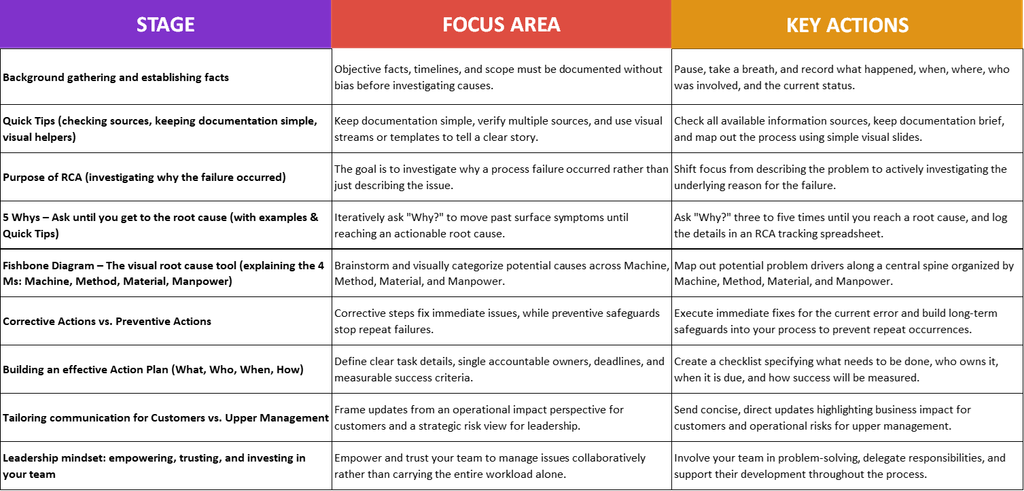
Background or Due Diligence
Any error causing friction can generate a much more serious impact on your process; as such, understanding what happened is CRUCIAL. When we think of background, we picture the entire story: what happened, when it happened, where it happened, who was involved, who and what was impacted, the current status, and any other relevant details. A common mistake here is jumping straight into root cause analysis. This is a big no-no!
Performing due diligence means starting a documentation process that helps you get the big picture. The questions you ask should all be pointed at describing the situation, not why the situation appeared.
Keep in mind that background gathering is a non-judgmental process. Leave whatever bias you have behind and try to stay as objective as possible. The more distracted you are by personal feelings, the less likely you are to find a proper fix. The core idea here is to establish the FACTS, because you will be using those facts later on.
Quick Tips:
- Make sure you check all sources – do not rely solely on one or two sources of information if more are available. Check everything!
- Don’t go crazy with the documentation: keep it short, simple, and with enough detail to cover potential questions. No one wants to read 3 slides of background story!
- Visual Helpers: process maps, schematics, and simple visual streams (like the ones you find in PowerPoint) can be of great help. You can also look at existing templates (either company-owned or built into PowerPoint). Some of them have great tables and slide designs that tell a clearer story.
Root Cause Analysis (RCA)
Enjoying those docuseries on Netflix? Want to be the storyteller, but never had the opportunity? Well, this is it. RCA is all about investigation. Unlike background gathering, RCA focuses on why the situation happened. The main thing we want to uncover is why the failure occurred.
To achieve this and be the best detective you can be, you need a bit of help. There are many tools used for RCA: 5 Whys, Fishbone Diagram, Pareto Analysis, Failure Mode and Effects Analysis (FMEA), Fault Tree Analysis, and many more. In this article, we will focus on two of the most common ones: 5 Whys and the Fishbone Diagram.
5 Whys – Ask until you get to the root cause.
The principle here is simple: ask “Why?” until you reach the root cause. The trick, however, is linking the second question to the first answer and knowing when to stop.
For example:
- Why did you eat the apple? I was hungry!
- Why were you hungry? Because I skipped breakfast!
- Why did you skip breakfast? Because I woke up late!
- Why did you wake up late? Because I went to bed too late.
The biggest challenge when doing this for the first couple of times is knowing when to stop. Once you reach an actionable, underlying answer, stop. Don’t go overboard, usually 3 to 5 Whys are enough to reveal the root cause.
Quick Tips:
- Don’t fall for generic excuses like “I wasn’t paying attention! “This is a vague and superficial explanation. Mistakes are generally not rooted in a lack of attention per se; that is merely a surface symptom. The scope of RCA is to uncover the underlying cause.
- Have the conversation with the person who made the mistake in a calm and supportive environment. People are far more likely to give you honest answers if they trust you and don’t feel threatened.
- Use tools: keep an RCA Excel template where you can capture valuable details about the error. A simple format could include: Date, Error Made By, Error Reported By, Process, Sub-process, Financial Impact (if applicable), Status, Description of Error, Why 1, Why 2, Why 3, Why 4, and Why 5.
- You don’t need to fill out all five Whys every time. Sometimes you find the root cause on your 2nd Why, sometimes on your 5th. Either is fine.
Fishbone Diagram – The visual root cause tool.
The Fishbone (or Ishikawa) Diagram is a perfect tool when presenting to an audience that responds better to visuals than traditional spreadsheet reports. In essence, it is a structured brainstorming tool designed to identify, categorize, and display potential root causes of a specific problem. This method places the main problem on a horizontal central line, with branching lines categorizing various causes and sub-causes.

Think of it as a fish skeleton. Each major branch connecting to the spine represents a broad category (often referred to as the 4 Ms):
- Machine (Equipment / Systems): everything related to tools, hardware, software, or machinery involved in the process.
- Method (Process / Procedures): how the work is performed and the specific steps taken to complete the task.
- Material (Inputs / Supplies): raw materials, components, data, or consumable items required to deliver the output.
- Manpower (People / Personnel): the human element executing the process.
To each major category, you add specific sub-causes (1, 2, or more), depending on your unique process and industry.
Corrective and Preventive Actions (CAPA)
You just finished your first RCA! Great job, but your work isn’t done yet. Identifying the root cause isn’t enough in today’s business environment. Knowing what caused an issue won’t help unless you fix the immediate problem and prevent it from recurring. This is where CAPA comes in. Upper management and customers don’t just want to know why things happened; they want to know how you are managing the fallout and, more importantly, how you will ensure it doesn’t happen again.
Corrective Actions are the reactive steps you take to fix the issue right now. Here, you explain what immediate actions were taken to fix the error, how it was corrected, and who carried it out.
Preventive Actions are the proactive measures you take to prevent recurrence. This includes process safeguards (double-checks, audits, cross-checks, automation, etc.) that act as blockers against future errors. This section outlines how you are mistake-proofing your process for this specific issue.
Quick Tips:
- Track CAPA in the same spreadsheet you use for RCA. Placing CAPA columns directly after the root cause allows you to track root causes and their resolutions in one place.
- Use CAPA data over time to evaluate which preventive actions are effective and which fall short. This data will prove invaluable after a few months of error management.
- Keep CAPA concise: no need to write a novel. Stick to clear, actionable points (e.g., automated validation checks, updated SOP documentation, process cross-training).
Action Plan and Stakeholder Communication
You are almost done! Another mistake newer managers make is either failing to communicate the action plan or doing so ineffectively. Ironically, I reviewed an escalation response recently from a tenured manager who wrote: “Thank you for bringing this to my attention! We take these situations very seriously. The error was corrected, and since this happened due to human oversight, I can assure you it will never happen again.” This is a textbook example of what NOT to do.
An Action Plan is a clear, step-by-step checklist required to reach a goal. Think of it like a GPS: your goal is to reach Address X, so you input the address and hit START. The action plan is the step-by-step guidance. In RCA, an effective action plan answers four core questions:
- What needs to be done? (The specific task)
- Who is going to do it? (The single accountable owner)
- When will it be finished? (The deadline)
- How will we know it worked? (The measurable result / success criterion)
When communicating with Customers and Upper Management, tone, clarity, and perspective MATTER. You shouldn’t send the exact same message to both parties. Customers expect a business-oriented perspective (impact on their operations, timelines, or financials), whereas Upper Management requires an internal strategic view (project impact, SLA’s, penalties, and operational risks).
Quick Tips:
- Keep communications concise, fluff-free, and direct. Attention spans are shorter than ever, so avoid dense blocks of text.
- Use BOLD text strategically to emphasize critical points, but don’t overdo it, less is more.
- Before sending, step away for 15 minutes, re-read your message with fresh eyes, and then hit send. If you’re unsure, ask a colleague for a quick peer review.
- Maintain a calm, objective tone. Avoid overly dramatic language, keep it professional and solution-focused.
Final Thoughts
While escalation management may seem intimidating at first, the core principles are straightforward: stick to your methodology, gather facts, involve your team (you’re a leader now, don’t carry the load alone), establish clear actions with deadlines, and follow through. The first few incidents are always the hardest, and then things start to make sense.
Always remember: as a leader, your job is to help your team grow! They can’t develop if you do all the heavy lifting yourself. Trust, invest in, and empower your team.
Stay healthy, stay happy, and help others whenever you can! Have a great one!