
How do I clarify who does what on a complex project?
Ever wonder how people just know what they are about to do? Or how in some teams everyone is just on top of every little aspect they must deliver on, even if they have hundreds of things to do? In complex environments, where we work on projects and different initiatives all the time, with deadlines and multiple tasks and stakeholders to manage, it seems impossible someone would remember everything they should be doing, yet people are – so the question is what or how are they doing it?
A common mistake of the first-time manager is assuming things we need to manage are naturally stored in our brains and we know exactly what, where, and how to deliver then. This is in fact not true, as many use different “tools” or “fixes” to bypass any need to actually keep a mental track of everything. One of them is the RACI matrix. While a powerful tool by itself, the real shine will be visible when you are dealing with complex projects, with multiple stakeholders that all must deliver at a specific point in time.
How can a RACI matrix improve my quality of life in complex projects?
A RACI matrix saves your sanity on complex projects by ditching corporate chaos and endless guessing. By assigning one clear owner per task, it eliminates duplicate work, stops painful bottlenecks, and cuts through ambiguity so your team actually knows who is doing what – giving you your peace of mind back.
In this Article:
- The cost of ambiguity: Ambiguity, corporate jargon, and lack of clear ownership create daily chaos and unnecessary stress for first-time managers.
- RACI: The Basics: A RACI matrix is a practical responsibility table evolved from decades of management science that defines who does what on a project.
- The Eternal Conflict: Duplicate work: Establishing clear boundaries with a RACI matrix eliminates frustrating duplicate work, wasted effort, and team friction.
- The SPA: Implementing a Single Point of Accountability gives you a clear person to answer to leadership and empowers owners to bypass bottlenecks and make tough calls.
- Keeping it simple: Keeping your project plans clean, acronym-free, and fit for a single slide ensures your team stays focused and aligned instead of decoding corporate nonsense.
The cost of ambiguity
Sometimes work in the corporate office can get a bit crazy: people talking over each other, saying one thing and meaning another, complex processes with low-hanging fruit and bad design, different levels of interest, high pressure to deliver fast and cheap, and many more. Confusion and chaos are two very real and omnipresent aspects of this life, especially when doing this job for the first time, because without prior exposure and hands-on practice it’s very hard for a beginner to understand everything happening. I know this firsthand, and thinking back at my first few months as a team lead, I can’t help but picture the huge amount of confusion in the room – meetings where we needed to work on a big project together, everyone talking at once, many updates and changes in real time, so much corporate jargon I was not familiar with, and the fear of speaking so as not to appear… dumb.
The biggest setback in these situations is the huge amount of ambiguity, especially in meetings where something is decided and everyone assumes the rest will take charge and manage. Unclear next steps, assumptions on who is managing what and when, lack of proper ownership from upper management, and the overall chaotic mess that comes with it.
To add to more, we now also have to deal with corporate acronyms. Personally, I completely disagree with this practice: it’s unproductive, sounds very pretentious, and most times very unintuitive – with acronyms not even properly calibrated with the context. Listen, I love a good wordplay just as much as the next person, but when we start to speak in jargon things get a bit absurd, like those random parody clips you see of people talking in corporations.
We all work with the famous spreadsheet, and we’ve been doing this since the nineties, so why not turn something everyone is familiar with into a powerful tool to point out ownership and establish proper accountability? This is why RACI is such a simple, efficient, yet powerful tool: a simple spreadsheet can become a clear work-instruction project plan with very clear and specific owners and next steps – something everyone can look at and immediately understand.
RACI: The Basics
What is RACI anyway?
In simple terms, RACI is a responsibility table that will allow people to understand who needs to do what on a project. Using it will remove any guessing from the discussion and define clear roles and responsibilities for every single task. This is the quick lore of it:
- It doesn’t have a single owner responsible for its creation, but it’s more an evolutionary process based on decades of management and scientific input in the corporate environment.
- Its earliest ancestor would be the Linear Responsibility Chart introduced in the early 1950s (LRC). Back then, with companies rapidly expanding, people had a very hard time tracking who was doing what, and because of this a lot of progress was just stalled. As a response, companies started to introduce the LRC to mitigate the risk and push progress on.
- Between 1960 and 1970 it became Responsibility Charting, with people like David I. Cleland and Wallace Munsey (who pushed project management concepts) and Richard Beckhard and Reuben T. Harris, who actually formalized the concept in their 1977 book Organizational Transitions: Managing Complex Change.
- Later on, between 1980 and 2000, many iterations of the concept started to appear and be more widely used, with the Project Management Institute finally cementing the RACI concept as we know it in their PMBOK Guide (Project Management Body of Knowledge).
Decoding the acronym
In essence, RACI is (ironically) an acronym, and it stands for:
- R – Responsible: The doer. This is the person who rolls up their sleeves and actually executes the work to get the task done. (Rule of thumb: There should usually be only one primary driver per task to avoid confusion.)
- A – Accountable: The owner. This is the single person who has ultimate ownership and veto power. If the task succeeds or crashes, it stops here. They answer for the final result. (Rule of thumb: Never more than one “A” per task. Shared accountability is no accountability.)
- C – Consulted: The expert. These are the people whose opinions, advice, or input are needed before making a decision or finishing the work (two-way communication).
- I – Informed: The audience. These people need to be kept in the loop on progress, milestones, or outcomes, but they don’t need to approve or contribute (one-way communication).
A very basic and simple example of what a RACI looks like is this:

To make RACI work, two things are crucial: every task has exactly one driver and one owner. This way you make sure ambiguity is eliminated, since having multiple people manage one task can create a lot of chaos. If you find yourself in a situation where a specific part of the project must be managed by two or more people, just break that step down into individual bite-sized tasks that can be handled by one person, thus eliminating the need to ever put more than one person on the job.
The basic function RACI will fulfill is to eliminate any gray areas, in such a way that people will know exactly what is expected from them. When we have too much clutter on a single task, especially from a human effort perspective, things get messy and unclear. I know we all want to believe in the bettering of humanity and concepts like the next-level evolution and breaking standard norms, but that’s just fluff from social media. This doesn’t happen in real life, so why pretend it does? When we just accept who and what we are, we stop trying to fight the inevitable, accept reality, and find solutions that actually work.
The Eternal Conflict: Duplicate Work
A great side effect of using a RACI matrix is stopping the ever-present duplication of work. Think about it: multiple people working on a project without a clear “who does what” – there is a very high probability that you will have at least one case of duplicate work in the immediate future. The removal of this duplication is not just about the effort itself; it’s also about the stress, discussions, debates, and sometimes even anger. People get very personal, especially if someone else is stepping into their area of expertise. Besides that, when multiple people do the same task without knowing the others are also doing it, with so much diversity of thought, it’s highly probable that you would get at least as many different ways of doing this. All this leaves a lot of room for errors, too many potential risks, unnecessary effort, and waste.
To stop this, or at least mitigate as much as you can from it, you first need to establish clear and universally understood boundaries. They will provide the exact context for each person, create a clear view of what everyone is supposed to do, where to start and finish, and lastly give sufficient visibility in order to avoid cross-working on the same thing. Think of it like a personal property plan, but for tasks.
Also, on this topic, there’s the issue of people stopping what they are working on because they keep bumping into each other on some of the more unclear tasks. For this reason, a RACI matrix can help eliminate some of the added pressure by telling people or providing the proper “place” that can inform them about what they are responsible and accountable for, and where they should be informed and/or consulted.
The SPA
Loving the acronyms, right? Don’t worry, I’m just using them now to highlight the bizarre situation we end up in when the corporate way of working creeps in and everything – everywhere – turns into capital letters with a “secret” meaning.
The Single Point of Accountability is all about a clear and undisputable picture of who is accountable for what. In the absence of a tool like the RACI matrix, many of us find ourselves in this confusing and very hard-to-navigate environment with a lot of questions on what you and/or other people are doing. The way I see it, it’s like a very expensive plate (those that you only keep to show, never to use) getting dropped and shattering. Suddenly it’s a problem everyone is responsible for, yet no single person is. The same thing happens with unclear and less structured project plans (or day-to-day tasks) that lack the proper overview.
It’s very important to establish who is answering to leadership and customers, and to other stakeholders when things don’t go as planned. As a leader, you have to cover the basics and make it crystal clear who the people in charge of things are. If you don’t, one person’s mistake becomes a team issue, thus leading to lower morale and added pressure on people who are – by all means – not at all accountable for it.
On the other side of it, having a proper point of accountability at the individual level will also empower the owner to make the tough calls and move things along. When people know they are in charge of something, and that they can manage it however they want, it’s much easier to bypass hurdles, invest less effort in trying to answer one question by going to five other people, or just stopping the entire thing to hear from multiple layers. In truth, it’s about eliminating potential bottlenecks that normally creep into your process when things are not clear and people feel the need to ask, wait, or consult too many people before making a single decision. Empower, don’t impoverish.
Keeping It Simple
A recurring thing you might have noticed is that I always come back to this saying: keep things simple. I believe many of the issues people have these days revolve around this constant habit of making things way too complicated for no reason. What is the point of trying to make your life harder? When we go back to these basics, and relearn how to not overdo things, we return to a more efficient time when you just do something (simple, efficient, and as fast as you can) without thinking about so many other things. Focusing on potentials is fine for very specific situations, but most things in life are not like that. Just do it – I know it sounds like product placement… but they are on to something!
Across time I have been a direct witness to thousands of very complicated and sometimes ridiculous plans for the simplest things. You recognize them because you need at least five minutes to go over them and understand what they are about.
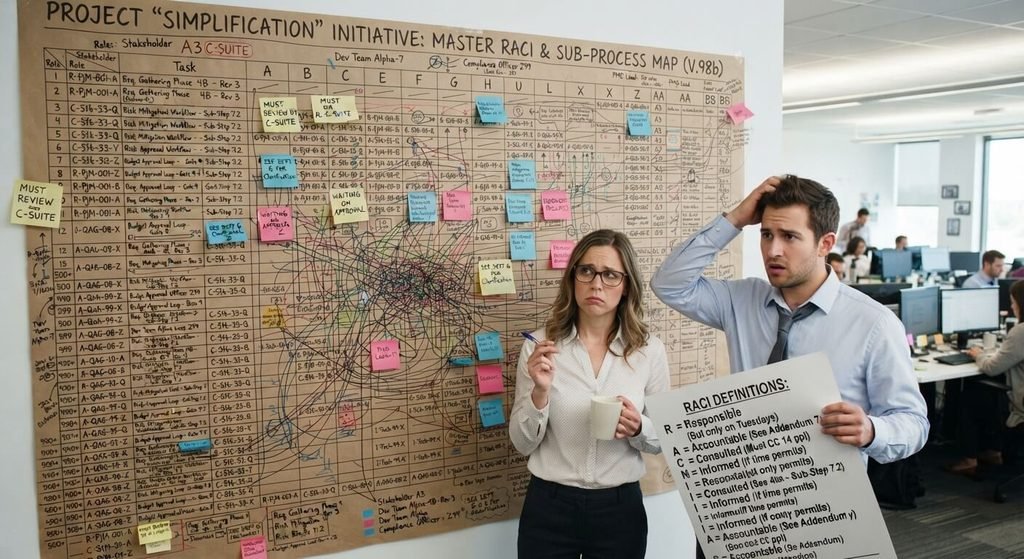
People really don’t need this – we are not in a Netflix docuseries trying to decode a century-long conspiracy. If your project plan can’t fit on one page or slide, rethink it and redo it. Create grids with information that is easy to follow, simple, and accessible for everyone. Here are some of the things I take into account when crafting a project plan:
- Limit the usage of acronyms and very specific and/or complex terms to a minimum.
- Make sure the wording is easy to follow.
- Don’t go crazy with arrows, images, or other visually heavy elements (the more you add, the worse it gets). Try to make use of negative space; there is no need to fill every single pixel in your slide.
- Be specific, clear, and assign clear owners – nothing should be left to personal interpretation.
And yes, this takes a lot of time on your side! You can’t expect excellence when you don’t put the effort in. You can think of it as a 5S exercise.
Last note here: keep in mind that when things change or you have updates, your RACI matrix must also be updated and reshared with everyone. Depending on the complexity of the project, external and internal factors, this might happen more or less frequently. Think of this as a must-check file: both for you and the people involved, the go-to place they have on their desk or constantly open.
Let’s take an example and see what that could look like. Say we are in the middle of a project to improve the average handling time in our team. We have a bunch of people involved and a lot of things to do. After multiple sessions of brainstorming and planning, we managed to narrow down all the things we need to do:
- Analyze current AHT drivers and root causes
- Map and streamline call/chat workflows
- Audit and update internal knowledge base articles
- Design and deliver agent coaching modules
- Evaluate customer satisfaction (CSAT) impact
- Optimize CRM shortcuts, macros, and ticket routing
- Review weekly performance metrics and adjust targets
Now let’s translate them into a more structured, to-the-point, and simple framework.
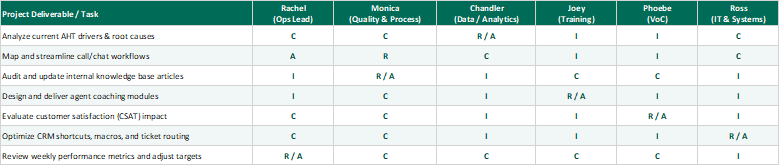
Nothing complicated, no complex visuals, no need to have a PhD to decode this, or to have access to whatever complex tools and/or systems to make it: a simple table in Excel that anyone can do.
In the end, a leader’s role from this point of view is to build a calm and aligned team that can focus on what they actually need to deliver instead of trying to decode complicated project plans or get confused and stop efforts because things are not clear.
Until the next one, stay happy, safe, and healthy!