
How do I stop solving the same surface-level problems over and over?
For any people manager (and sometimes Subject Matter Experts), the terms “RCA” and “5 Whys” go hand in hand, and are very established and well-known concepts. But what happens when you are new to the role, you’ve never had to deal with root cause analysis before, and you have absolutely no idea how to tackle this subject?
In the day-to-day job of a leader, they will inevitably have to do a bit of detective work on a bunch of different things: a strange situation with a customer, an order getting stuck, low engagement, bad KPIs, loss of revenue, attrition, a decrease in CSAT scores, etc. When this happens, we use the 5 Whys Analysis. Today, we will demystify this concept and teach you how to master it as a first-time manager.
What are the main points to consider when doing a 5 Whys analysis?
The 5 Whys tool helps leaders solve problems by targeting underlying processes rather than surface symptoms or assigning blame. A great 5 Whys analysis shifts from reactive quick fixes to finding true root causes. By using objective data, involving team members, and focusing on controllable processes, you can turn insights into small, lasting fixes that build an open culture of learning from mistakes.
Your first-time manager Roadmap for 5 Whys:
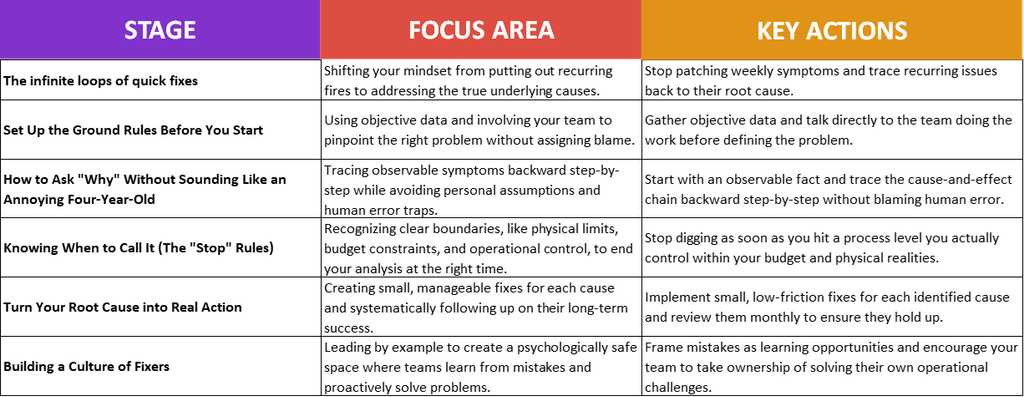
The infinite loops of quick fixes
If you are a frequent reader of this blog, by now you should be familiar with the concepts of root cause analysis and Kaizen. In case you are not, here are some articles to get you started: Root Cause Analysis (RCA): The Starter Pack and Small Process Improvements: The Kaizen Way.
If at any point you want to check out the entire library, here is the simple view:
- Main Library – with all articles.
- Build – library specifically dedicated to the first stages of management.
- Lead – library containing all leadership concepts and related topics.
- Measure – library with all our data analytics and related topics.
- Optimize – library with all articles surrounding the concepts of Lean, Six Sigma, and Continuous Improvement.
It happens sometimes, especially for newer managers, that they get caught up in a strange loop of fixing something with a specific frequency (let’s say every Monday morning). This can happen due to an incorrect assessment of the issue. Many people look at surface-level factors and just assume they are what’s actually causing the problem. In reality, they are not, and while you struggle with fixing them every week, the underlying issue just keeps growing.
To make a very simple analogy, this is about putting out the fire versus eliminating the matches causing said fire. With processes and people, we need to make sure that we’re not just fixing the immediate issue at hand, but are also fixing the actual cause in such a way that the issue will never appear again. So, we think about it in terms of both reactive and proactive approaches.
Because social media tends to get very “upper-class language” about different concepts – especially nowadays – let’s put the 5 Whys in very simple terms: the 5 Whys is a tool you can use to get to the bottom of an issue. Ironically, more or less everyone in the world has used it at some point in their lives, especially when we were children trying to understand different topics. Much like a kid, in 5 Whys we keep asking WHY until we get to the bottom of the issue.
For example: I got a lovely glass of lemonade that did not taste good. So, let’s see why that is by asking a few whys.
- We start with the easiest of them: Why does the lemonade taste bad? The answer could be: The balance of flavors is completely off; it is unpleasantly tart and lacks any sweetness.
- Then we link the obtained answer to the next why: Why is it unpleasantly tart and missing sweetness? Let’s say the answer is: No sugar or sweetener was added to the mixture while preparing it.
- Repeating what we did in step 2: Why was no sugar added to the mixture? Maybe the person making it followed a pre-written recipe card that completely omitted the sugar measurement.
- And we link again with the answer from step 3: Why did the recipe card omit the sugar measurement? The card was a rushed, handwritten draft created quickly during a busy shift without being reviewed against the standard recipe.
- And the final one: Why was an unverified draft used instead of an official standard recipe? There is no standard operating procedure or checklist requiring recipes to be verified and printed before being placed in the kitchen/station.
Following this example, if you are the manager of this lemonade stand, you might be tempted to just go with the first answer – the one regarding the balance of flavors – and take so many other actions trying to get the balance right, when in reality the issue was with the recipe they were using not being the correct one. This additional time spent fixing the wrong thing is exactly what I was mentioning above: wasted time spent fixing the same issue over and over again.
Set Up the Ground Rules Before You Start
A good 5 Whys process starts with a good setup. Many first-timers have a difficult time trying to actually pinpoint the right problem. You don’t need to deep-dive into absolutely everything in your process or team, and you will for sure not get anywhere if you try. Take a step back, check your objective data, and locate the right problem you are trying to solve.
It helps if you take advantage of a mix of things:
- KPIs and SLAs
- Volumetric Data
- Accuracy
- Experience or Tenure of the employees
- Using your Subject Matter Experts
- Any reports you might have that can help you identify the problem
The faster you locate the right problem, the faster you get it taken care of. But always remember that the best way to approach things is step-by-step: take 1 problem at a time. Handling too many struggles at once is not healthy.
Another mistake people make is not getting the right people in the room when trying to identify the problem. Don’t assume it’s something without checking it in detail with the ones who are actually doing the activity. Take input from them, ask the right questions, listen, and take notes. Assuming the problem on your own is the death of leadership. You manage these people; you are not an individual contributor.
BLAME is a word that should not exist at this point in time. Very often, I see managers embracing the mindset of “well, I know John made a mistake here; he always forgets to do that.” This is, first of all, not correct, and second of all, not the appropriate response from a good leader. To blame someone or to act on a specific bias (regardless of how much experience you have) is the worst thing you can do: it will create a gap between you and that person, the team will see you as the Higher Manager who doesn’t care, and people will react in the future based on that feeling: fear.
How to Ask “Why” Without Sounding Like an Annoying Four-Year-Old
First things first: start with the observable symptom. Much like the lemonade example, the first why must be about what you can observe, not what you think is happening. This is important because the way you start your analysis will dictate whether or not it’s correct. When you insert your own assumption as the first why, you automatically drag the entire process from the observable into the subjective. Your goal is to reach the actual root cause, not the one you think might be happening.
As much as possible, try to follow what we call the cause-and-effect chain backward step-by-step. This chain is all about action and reaction: whatever action occurs will have a specific effect. Your job is to look at this from the effect to the cause – meaning, if you observe something happening, what caused it?
Don’t spend too much time on the human error aspect; much of the time, it’s not actually the core cause. Yes, humans make mistakes – this is a given. However, when performing a proper root cause analysis, the phrase “it’s a human error” is usually something people use out of laziness, or because it’s much faster and easier to state. Focus on the process-related aspects and the missing safety nets; this will lead you down the correct path.
Knowing When to Call It (The “Stop” Rules)
The best way to look at this is: stop when you hit a process you can control. Of course, you can continue with the 5 Whys until you reach some strange level where external factors are responsible, but ask yourself this: can you control them? If the answer is No, go back to the step that involved a process you can control. It’s there where you will make an impact and implement a correction.
Another way to address the question “when should I stop?” is by checking the answer against two important criteria:
- Is this something you can’t change because the laws of physics don’t allow it? This rule stops you from digging into foundational facts of nature, human physiology, or basic operational realities that you cannot engineer away. Dig deep enough and you will eventually reach one or more of these aspects that, ultimately, you cannot change.
- Is this something you can’t change because it impacts the company budget? This rule stops you from proposing abstract, multi-million-dollar “fantasies” when you only have control over everyday team execution. You will not find many companies out there that are willing to treat every single nook and cranny of their process like a major investment and sacrifice a lot of budget to repair it, especially when the fix can come from a different angle. Remember: business is about making money.
A good golden rule is this: if your fix requires humans to never make mistakes again, keep digging – this is not the answer you need. I’ve said this before and I will say it again: it’s in the nature of the human experience to make mistakes. There’s no living (or dead) person on this planet who has never made mistakes. It’s not possible mathematically, physically, mentally, or across any other layer you want to add. Our nature is to experience and learn, and part of experience comes with mistakes, like babies learning about things by interacting with them. They won’t know how sour something tastes until they try it and realize… oops, that’s a mistake, it doesn’t taste good.
Turn Your Root Cause into Real Action
A solid 5 Whys analysis pairs each “Why” with a “how to fix it.” This means you need to identify potential fixes for each of the whys you come in contact with. This way, you get a better picture of what each solution involves, and you better understand the impact and other effects that might influence your process and people (whether positive or negative).
Don’t go crazy with BIG changes: people don’t like big changes, and neither do companies, for that matter. When you go for big changes, there’s a lot to unpack: how will this change the way of working? Will it discourage employees? Will customers like it? Go for the easy, small, and quick fixes; these are the best to implement and produce the least amount of negative friction.
Follow-Up! Another thing people tend to forget: once you make a fix, don’t just leave it there and pray to the gods of chance that it will stay fixed. Make a habit of checking these fixes (at least once per month) to see if they hold up. If they do, great! But if they don’t, you need to go back and try again.
Building a Culture of Fixers
With more than 15 years of leadership experience, I can tell you this: it’s better for you and your team if you start working on a “culture of fixers.” This means you need to show, guide, and help people become problem solvers. The idea of waiting for a solution to magically arrive is not in anyone’s favor, so you might as well start addressing things yourself. The more you spread this habit to your team, the more involved they get in fixing issues, and the better off your processes and people will be.
It helps a lot if you manage these issues openly and show people that it’s perfectly OK to make mistakes. Don’t try to keep things behind thick walls or in private meeting rooms; have open talks with the entire team, share these practices, and let everyone see that being human is not wrong – it’s actually a big advantage. Without mistakes, we never learn, and when we don’t learn, we don’t evolve.
Try the down-to-earth approach and don’t add friction to these sessions. Keep them light, and don’t use them to shame others or point fingers. The idea is to create a space where people are encouraged and appreciated, not blamed and shamed.
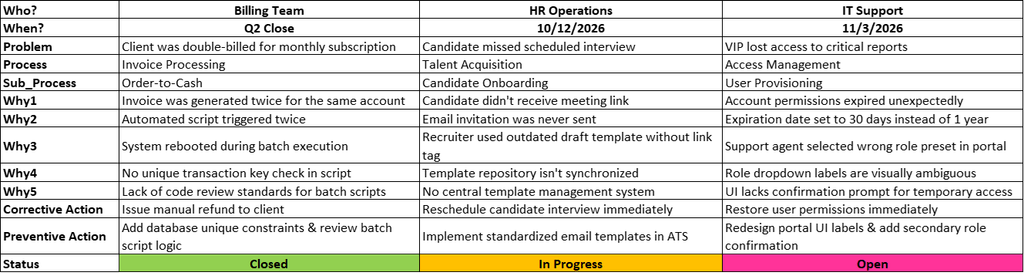
If it helps you out, here is an example of a good Excel template for 5 Whys (I just transposed the table because it fits better this way; normally, it would have the steps in the first column and the description in the header).
Until the next article, stay safe, happy, and healthy!