
How do I ensure everyone starts a project with the same expectations?
As a first-time manager, dipping your toes into the complicated and turbulent waters of project management can feel like a serious mountain climb instead of a quiet walk in the park. It’s not easy to deal with something that has so many potential complications, numerous stakeholders, meetings to set up, checks to perform, and, above all else, a tight and strict plan to maintain.
If you are familiar with my knowledge base, you probably already saw the article Project Management Basics for Non-Project Managers, where I provided an overview of the fundamentals anyone unfamiliar with project management should be aware of. But what should you do before starting the actual project? What is the best way for a first-time manager – or someone without prior experience – to kickstart a project while making sure everyone is aligned?
The best way to kickstart a project with clear alignment is to complete key preparations upfront, establish structure, and communicate clearly. Define RACI roles and schedule structured connects early. At the kick-off, use simple visual slides and establish clear success criteria. Finally, track risks proactive in a shared file and lock in next steps using written Minutes of Meeting.
In this article:
- Before PK (Project Kickstart): Focuses on pre-project preparation, including defining team roles, scheduling organized meeting connects, and setting up a clear project charter.
- Running the Kick-Off Meeting: Covers leading the initial alignment meeting effectively by using visual slides to present key details and agreeing upfront on clear success criteria.
- The Way Forward: Details post-kickoff essentials, focusing on proactive risk identification through a shared tracking file and closing meetings with documented next steps.
Before PK (Project Kickstart)
Nothing wrong with a bit of corporate jargon from time to time, am I right?
Before you do anything from the actual project plan, you have a whole bunch of preparations to make. To make it easy, let’s take an example of a project plan:
3-Month AHT Optimization Initiative
Objective: Reduce combined Customer Service Average Handling Time (AHT) by 27.7% (from 25.6 min to 18.5 min) across Phone and Chat queues within 12 weeks, while maintaining strict Customer Satisfaction (CSAT) and First Contact Resolution (FCR) quality floors for our 10 frontline specialists.
12-Week Roadmap & Key Milestones

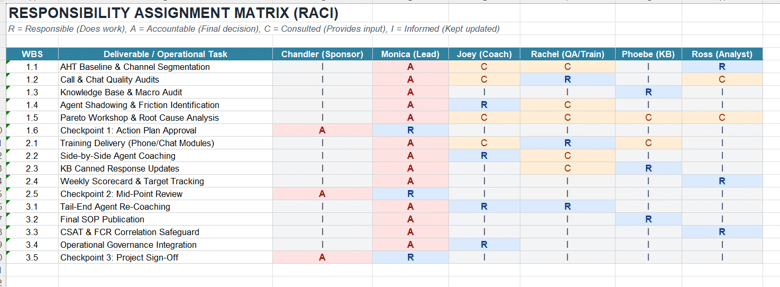
Team Structure & Ownership (RACI)
- Chandler (Sponsor): Executive sign-off and milestone gateway approvals.
- Monica (Project Lead): End-to-end project execution, timeline management, and risk mitigation.
- Joey (Ops Coach): Frontline side-by-side coaching and friction feedback loops.
- Rachel (QA & Training): Call control module creation and QA compliance monitoring.
- Phoebe (KB Lead): Canned responses, standard operating procedures, and macro navigation.
- Ross (Data Analyst): Weekly scorecards, baseline segmentation, and CSAT safeguard tracking.
With an overview of what we need to do in the next 3 months, it is time to think about what needs to go out first. Think of this as a logical exercise, always answering the question: what would the most logical next step be? Contrary to very fancy posts about project management, real operational applicability is less about “focusing on XYZ concepts from the Book of Project Management” and more about how you can incorporate “the best for you” concepts into the plan. Managers trying to make improvements are not certified PMs, so there’s no need to have a complex plan circulating; you can manage just fine with a set of basic tools (which you already have access to), a few nuggets of methodology knowledge, and a lot of common sense.
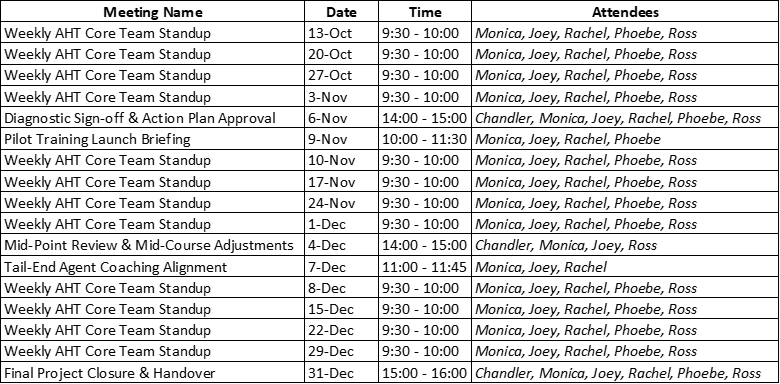
Since you will act as the PM and you have an overview of what you will be doing (assuming people are already aligned on this), it’s time to take the first step: setting up the meetings. As any good organizer, you need to lay out all the connections (one-time and recurring) that are about to happen over the next 3 months. Here is an example I created for our project plan: a basic table with the meeting name, date, time, and required attendees.
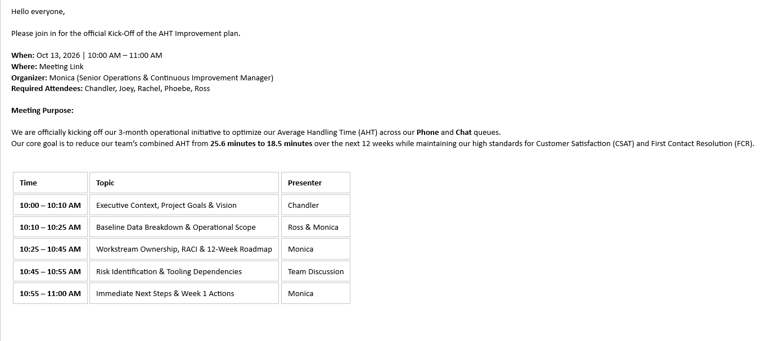
With the meetings organized, it’s time to send those invitations. On this topic, please keep in mind that a bit of effort should be put into them. Don’t go overboard, but don’t just send a blank meeting invite either. A good balance is to include details like the date and time, organizer, required attendees, and who will be talking about what. While it might seem like extra work, it’s better to have things planned rather than just “going with the flow,” as the “go with the flow” vibe often turns into a disorganized and unproductive call.
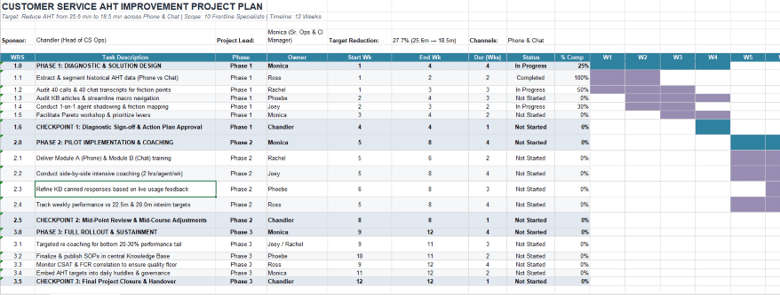
The next step is to make sure you have a proper project charter. This is an absolute must for any project plan, as its absence will push everyone and everything into complete chaos where no one knows what to do or when to do it. To achieve the right effect, I recommend complementing the project plan with a RACI matrix.
For the project plan, you can find many templates already in Excel (or on hundreds of websites), use AI to make one, or create it yourself—whatever works best for you. The goal is to outline all the activities that will be done during the project, along with the owner, timeline, and status.
Running the Kick-Off Meeting
You have your Excel files, project plans, matrix, and invitations in order, which is great. But what are you going to do when the actual kick-off meeting starts? Running it isn’t always as easy as 1-2-3, especially when you’ve never done it before, and the risk of things spiraling out of control is very high.
First-time managers often struggle with this part of the job, even after doing it a few times, because they lack a few essential elements: experience (a given, of course), a solid foundational platform, and the correct direction.
The foundational platform is the “tool” you use in these meetings (kick-off and beyond) to capture and display the current state. Some people use the project plan, others don’t use anything at all, while some use different iterations they find work best. I prefer a good old-fashioned PowerPoint slide that helps get the message across quickly, easily, and visually. It’s important to remember that we no longer live in an age where people process content the way they did 20–30 years ago. Since social media took over – especially in recent years with short-form video content – attention spans have shifted toward visuals rather than “lots of text and numbers.” People simply find visual information much easier to digest (ironic saying this on a blog). Here are two slides I made for our project to give you an idea of what I mean.
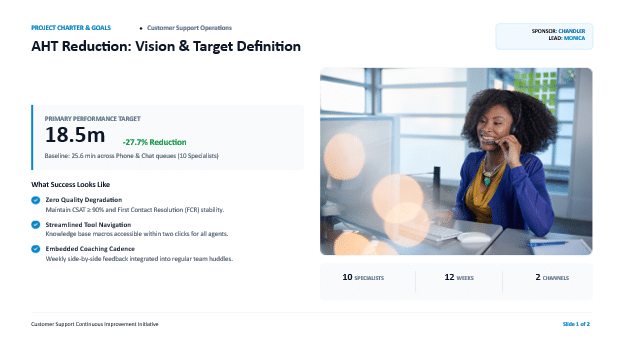
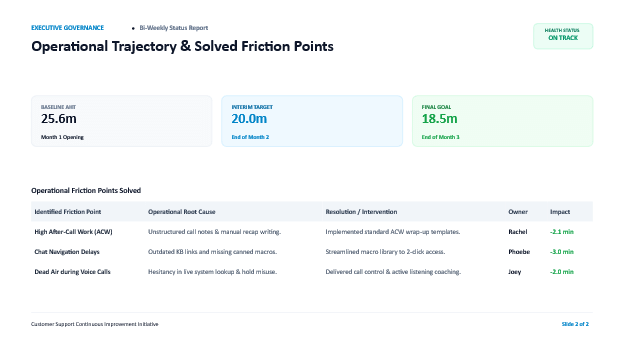
In them, you can find all sorts of project details: what we need to do, who the owners are, friction points, root causes, resolutions, and whatever else is needed. This will save you plenty of questions and help people better understand what needs to be done and how to do it.
All you need now is the right direction, which comes from establishing the success criteria. Projects that fail, take longer than expected, or produce completely unintended outcomes generally lack this. Agreeing on success criteria means ensuring everyone is completely aligned on what a good result looks like long before work begins. When people skip this, a lot can go wrong – mainly due to a lack of proper definition, clarity, and personal interpretation.
The Way Forward
Before you go out there and start kick-off meetings for various project plans, there are two more things we need to discuss: spotting issues early and managing meeting closures.
When it comes to issue spotting, we must address risks. Every project you undertake carries a certain degree of risk, and the sooner you understand this, the better off you will be. Risks are a normal part of operational life because we simply cannot control everything to the letter. Dealing with multiple people, tools, systems, and procedures will – without a doubt – create opportunities for things not to go as planned.
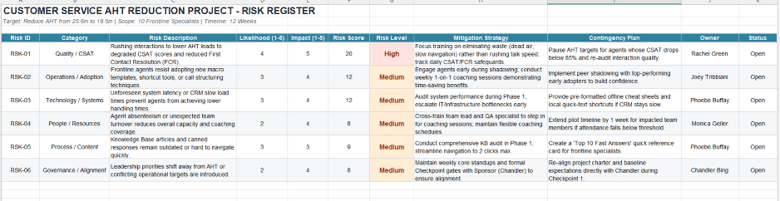
To avoid a major impact or having to create a mitigation plan when it’s likely too late, you – as the leader – must track risks beforehand. A simple Excel file where people can provide input on what you might be exposed to works perfectly. For our project example, I added a few fields (feel free to be as creative as you like):
- Risk Category: Where should we expect the risk? (Quality, governance, people, technology, etc.)
- Description: A brief overview of the risk with the necessary details.
- Likelihood: On a scale of 1 to 5 (with 1 being very low and 5 being very high), how likely is this to occur?
- Impact: On a scale of 1 to 5, how severe is the impact of the risk?
- Risk Score: A simple multiplication of Likelihood and Impact.
- Risk Level: Low, Medium, or High.
- Mitigation: What are we doing to prevent or minimize it?
- Contingency: How do we ensure this will not happen again?
- Owner: Who is responsible for tracking it?
- Status: Open, Closed, or whatever else you feel is needed.
The final element to consider for a great kick-off is locking in the next steps. A common issue for less experienced managers is letting people leave a meeting without knowing who is doing what next. Just before ending your meeting, go over what each person will be doing next, confirm everyone is aligned, capture it in the MoM (Minutes of Meeting), and send it out to the team. Again, it takes effort – I’m 100% with you on that – but it is totally worth it. Never hold a call without MoMs. If it helps, remember this rule: if it’s not in writing, it never happened!
And with that, you are good to go. Remember to plan ahead, stay organized, and focus on the immediate next steps (don’t take on too many struggles at once), while capturing any risks people anticipate. With a bit of practice, you will become an expert in no time.
Until the next article, stay safe, healthy, and happy!