
How to manage my old team now that I am their new boss
Well, this is awkward, isn’t it? Just a few weeks ago they were your peers, and now you have to lead them. If you feel scared, emotional, excited, and terrified all at the same time… then this is the article for you. I know this story better than anyone else. My first job in management was exactly this: leading my former peers. Like you, I had a mix of emotions, but nothing lasts forever. As with everything in life, this too shall pass. Until it does, we need to get you on the right track. Most first-time managers try to keep things as close as possible to how they were before: the same way of working, the same relationships. Right now, you might be thinking this is a great idea and the best way to avoid stressing out the team, but it’s not.
What should a first-time manager do when managing former peers?
Promoting to lead former peers shifts team dynamics from horizontal allies to vertical authority, often triggering psychological distance and status threats. To succeed, avoid pretending nothing changed. Address the shift directly through 1-on-1s, reset boundaries, and eliminate perceptions of favoritism by establishing fair, transparent team processes together. Finally, move away from top-down command and focus on facilitation, empowering your team through active support and open consultation.
Your Managing Former Peers RoadMap:
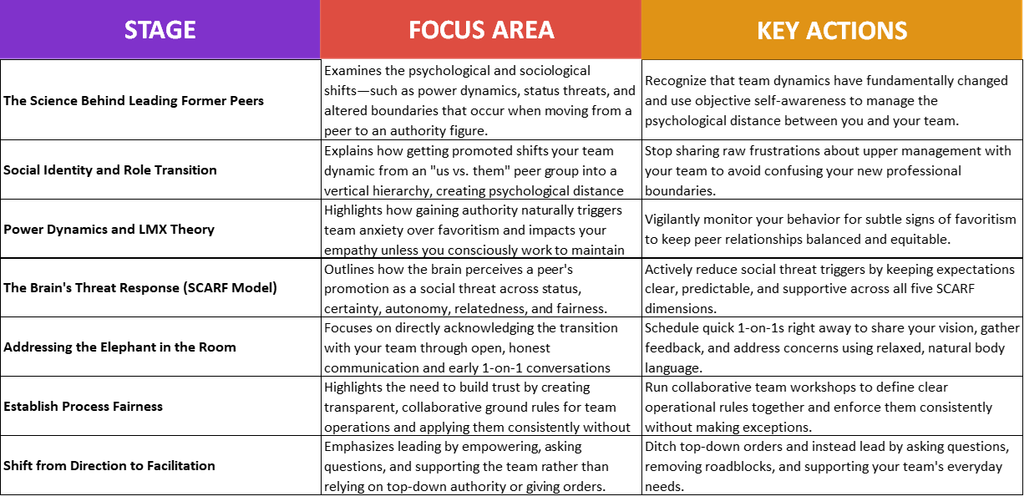
The Science Behind Leading Former Peers
Entire books and studies have been written on this topic, yet it remains one of the hardest situations to manage. It’s tough because these people used to be your teammates. You had a connection with them; you could vent about things you didn’t like about the job, the boss, the customer, and so on. Your promotion introduces two critical shifts:
- New Role Competition: You were selected for the role while others who applied didn’t make the cut (assuming there was a formal interview process).
- Shift in “The Way Things Were”: Much like the classic Barbara Streisand song, what existed before is no longer here today.
Navigating these two changes is difficult, which is why we must understand what is happening under the hood before moving on to solutions.
Social Identity and Role Transition
In sociology, Role Theory explains that every position in a group comes with behavioral expectations. When you get promoted, a crucial shift occurs: The “Us vs. Them” Dynamic. As a peer, you were part of the horizontal group identity (“us” – the team, often aligned against upper management or external pressure). Becoming the leader instantly moves you into the vertical authority structure (“them”). You must keep this in mind, as this shift in perception impacts every interaction going forward.
Another factor is Psychological Distance. You can no longer share raw, unfiltered frustrations about upper management with your team. Self-Determination Theory highlights that maintaining former levels of casual intimacy creates role ambiguity, making performance evaluations or tough feedback feel like a personal betrayal rather than professional coaching.
Power Dynamics and LMX Theory
In organizational behavior, Leader-Member Exchange (LMX) Theory focuses on the quality of relationships between managers and direct reports.
- Favoritism Bias: Before your promotion, you naturally had closer relationships with some peers than others. Research shows team members vigilantly scan a new leader’s behavior for signs of favoritism. Even unintentional warmth toward former close friends triggers equity concerns, as peers measure input versus output and react strongly to perceived unfair treatment.
- The Power Paradox: Dacher Keltner’s research at UC Berkeley shows that power lowers our natural impulse for emotional mirroring and empathy unless we consciously compensate. When you gain power over former equals, their brains perceive a threat to their autonomy, making them hypersensitive to your tone and decisions.
The Brain’s Threat Response (SCARF Model)
Neuroscientist David Rock developed the SCARF model to describe how the brain reacts to social dynamics. Promoted peers often accidentally trigger threat responses across key dimensions:
- Status: A former peer is now “above” them in the formal hierarchy. Their relative status drops, triggering a neurochemical threat response (cortisol/adrenaline).
- Certainty: They don’t know how you’ll act as a boss or if the ground rules have changed. Unpredictability creates anxiety about job security and daily operations.
- Autonomy: You now evaluate their output, reassign tasks, or set deadlines. This creates a perceived loss of personal control over their work.
- Relatedness: You are no longer “one of the crew” in the same way, leading to a sense of exclusion or the loss of a trusted social ally.
- Fairness: Concerns arise that previous casual conversations might influence evaluations, or that past friendships will dictate rewards and opportunities.
Now that we’ve covered the science, let’s talk about how to deal with it. In essence, the formula is simple: acknowledge the shift, reset boundaries, and distribute autonomy. But what does this look like in practice? Let’s break it down.
Addressing the Elephant in the Room
Managing former peers is a bit like working in the same office as your ex: don’t make things more awkward by pretending nothing happened. Ignoring the change and acting like everything is completely normal is the worst thing you can do. Issues we ignore in management tend to blow up later.
Talk to your team. Get feedback, see how they feel, and understand what they’re thinking. Explain your plans, goals, and what you hope to achieve together.
Quick Tips:
- Schedule 1-on-1s right away: Don’t hold these before your official start date, or people might view you as acting “high and mighty.” That isn’t the image you want to project.
- Ask for their input: How are they doing? What do they think should change or stay the same? Do they have concerns about the transition? Write down the main points.
- Share your plans and goals: Acknowledge that this transition is a big adjustment for you, too. Outline key focus areas, your vision for the team, and where you want to improve.
- Mind your body language: People are observing you through a new lens now. Avoid sitting with crossed arms or a stern expression. Relax, you’re talking to a fellow human being.
- Be natural: Don’t fake it. People will see right through it. They know you better than you think.
Establish Process Fairness
A big mistake first-time managers make is assuming their new authority gives them a permanent “veto card” to command whatever they want. Thinking “I’m the boss now” is as far from reality as another galaxy. People do not respond well to forced authority. They will, however, accept change if they believe the process is fair.
To build trust, you need a clear framework for fairness. A classic example is the schedule – specifically, arriving on time. Because you used to be part of the team (and might have arrived late yourself on occasion), you need to establish a transparent baseline: consult with the team and decide together how schedules will be managed. If the rule is “arrive late, stay late,” apply it consistently with no exceptions. Exceptions complicate your life because team members will view them as bias and favoritism.
Quick Tips:
- Identify key processes: Map out areas that need clear procedures, such as work schedules, approval flows, workload distribution, or client coverage.
- Run a team workshop: Work together to set the new ground rules. Involving the team makes the process democratic, ensuring that rules are respected regardless of personal feelings.
- Avoid exceptions: Exceptions create complex scenarios and waste time on unnecessary debates.
Shift from Direction to Facilitation
You might think a perk of management is the power to give orders. It’s not. Abusing authority alienates people quickly. Going forward, effective decision-making relies on proper leadership: consultation. Master this approach, and you will save hundreds of hours of pointless conflict.
Authority won’t make you a great leader, but your ability to ask questions, support the team, and empower them will. Think back: What did you want from your former bosses? What could have been done differently? What would have helped you succeed? That is exactly what your team needs from you now. Giving orders is easy; being a true leader takes real effort.
You can read more about this shift in my article: Doing Everything Myself: From Doer to Enabler. In it we explore the idea of not only changing the role and the difficulties associated with it, but also how to actually transition from the “let me do it” to the “let me help you get there”.
Final Thoughts
While managing former peers feels daunting at first, it is far from impossible. Step back, do your research, organize your plan, adapt as you go (rigidity is a red flag in management), and be the leader your team needs right now.
Get into the habit of writing things down. This transition is a major shift for you too, and there will be a lot to track. Writing helps clear your mind and track progress. Experiment with different approaches and scenarios. If something isn’t working, don’t keep repeating it, just adjust your approach.
Stay healthy, stay happy, and help others whenever you can!