
How do I motivate people without giving generic “good job” feedback?
Ever had a connect with your boss, just for them to tell you some really generic-sounding feedback like “good job”? What about those very annoying emails and replies people send once someone has an achievement, where they all just mass reply with “great job” or “congratulations”? If you are like me, then you absolutely HATE this type of behavior because it belittles you in a way and makes you feel less important in another way, as everyone is just saying the same thing. To be a good leader is to know how, when, and what to say when talking to people, to be genuine, and to say words that have meaning.
Stepping away from the generic “good job” bit that somehow everyone in a corporation automatically learns is a hard job: it’s about knowing yourself, knowing other people, and actually wanting to be different.
How should a first-time manager deliver actionable praise and recognition?
Generic praise like “good job” breeds confusion, favoritism, and cynicism by devaluing real effort, so first-time managers must deliver specific, actionable recognition – using the action, context, and impact formula – while tailoring delivery to individual preferences, providing immediate feedback separate from criticism, linking individual wins to broader business goals, and building intentional recognition habits to genuinely motivate and inspire their teams.
Your delivering actionable praise and feedback RoadMap:
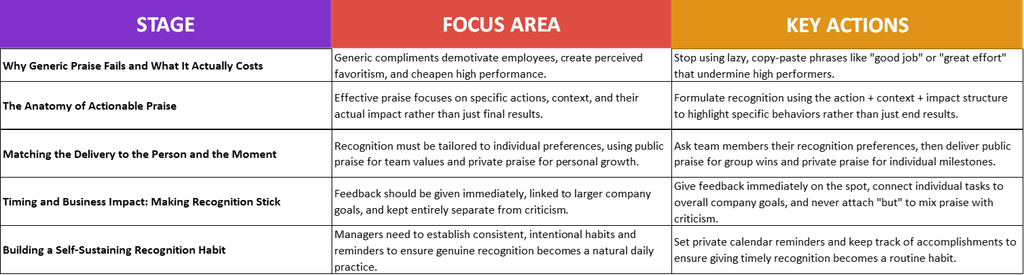
Why Generic Praise Fails and What It Actually Costs
There are a few generic words and phrases people use when it comes to this aspect, but the two most common are “good job” and “great effort”. While some argue that it’s a nice thing to recognize and appreciate someone, when your effort is just a simple copy-paste generic-sounding thing like “great effort,” it really defeats the purpose. You see, as humans we react to outside stimuli very differently from other animals: we are not dogs or cats that are very happy each time we hear the same word of praise. This is, in my opinion, because we need the specific praise to match our idea of why it is good, so when you say “good job” I don’t know what aspects you found to be good: was it some specific aspect, or was it the entire thing? What about those aspects that were less OK, the ones where I made mistakes? Are they also in the “good job” part? See, there is the issue with the generic: it doesn’t really allow any space for specifics, which is why you – a first-time manager – should avoid using it at all costs.
When we provide vague feedback, it causes a lot of confusion and can lead to a lack of motivation. I, for example, absolutely detest this type of feedback in the corporate world because I find it empty, and the more I get it, the less motivated I am to do better because I know people didn’t actually check, read, or understand what I did there; they just say something to be “nice”. The problem is, behind that “I am just being nice” lies a lesser aspect that we don’t talk about enough: people don’t want to deal with something in depth, so they just say things like this to “trick” other people into believing they care.
The “Teacher’s Pet” Trap
If your default feedback is a quick “Great work!” or “Awesome effort!”, you’ll naturally toss it to the people you interact with most: the vocal extroverts or whoever happens to sit closest to your desk. Because there’s no substance attached to the compliment, the rest of the room doesn’t see a clear benchmark; they just see favoritism.
The Devaluation of Real Sweat
Hollow compliments act like inflation for team morale: the more generic praise you print, the less any of it is worth. Imagine a senior specialist spending forty-eight hours untangling a critical operational mess, only to get the exact same “Great job!” as someone who remembered to submit their timesheet on time. It tells your top performers that you either aren’t paying attention or can’t tell the difference between baseline attendance and exceptional problem-solving. Over time, your best people stop pushing because extraordinary effort gets compensated with cheap currency.
The Cynicism Creep
When praise becomes cheap and unpredictable, team culture takes a hit. Instead of inspiring people, public recognition starts sparking quiet eye-rolls. Your team begins viewing manager shout-outs as political theater or brown-nosing rather than genuine appreciation.
The Anatomy of Actionable Praise
If you are on the road to change, and you really want to be the leader that inspires and motivates people, you need to start with the most basic aspect of actionable praising: move away from the vague and start complimenting specific behavior. When someone from your team worked a lot on some report, instead of “great report, Julie,” you can try something a bit clearer, like “Julie, I really liked the report! I looked over it and loved the way you managed the more complex customers, how you did the deep dive on service level, and how you cross-checked the quality score with the average handling time.”
If you are finding it difficult to do this – and I can understand, since you probably never did this before – you can try using a simple formula: action + context + impact. Let’s stay with the report made by Julie, and formulate something based on this example: “Julie, during yesterday’s monthly performance review, your breakdown of our top-tier client accounts stood out. By cross-referencing service level dips directly against quality scores and average handling times, you proved that our recent backlog wasn’t caused by poor agent performance, but by a sudden surge in complex customer inquiries. This saved us hours of misdirected troubleshooting and gave leadership the exact data needed to approve extra headcount for next quarter.”
Many managers tend to go directly for the final outcome, thinking that recognition of the finished product is what actually matters. But if you put yourself in the shoes of the person doing the work, you realize that work is not just about the final achievement; it’s also about all the things I did to reach it. This is why people have a hard time believing the “great job” remarks: they don’t show you appreciate all the other work that person did before reaching the final outcome.
Matching the Delivery to the Person and the Moment
Your next step in becoming a great leader from an actionable praise point of view is to know what type of person you are talking to, and adapt your strategy based on that. Some folk want more public recognition (either in a meeting with everyone, in an email sent to the entire team, in an email with the level 2 boss in copy, etc.), while other people would prefer a more intimate setting, just between you and them. When we don’t take into consideration these aspects, we do more harm than good, and if you don’t know better, don’t say anything until you do. And the only way you will know is by actually talking to your team and getting to know them.
In principle, public recognition is a powerful tool you can use to signal, strengthen, and develop team values. In general (of course, exceptions are to be considered based on each person/team/environment), you use public praising to enforce aspects that help out the entire group, not just one individual. Topics here can be many, but some examples I have used across the years are: team performance, reaching a very difficult one-time target, customer engagement, team spirit, and cooperation, etc.
Private recognition, on the other hand, is best used for individual growth and for those introvert wins. I have an entire article on this topic where you can learn more about extroverts and introverts from a first-time manager perspective: Leadership Style: Should I Change Who I Am?
Timing and Business Impact: Making Recognition Stick
When they say timing is everything, they are not at all wrong, because it really is. Even in people management, knowing what to say and at what time to say it is everything. Immediate feedback will beat waiting for quarterly reviews any time. I know at least 10 managers who have these useless frameworks where they have a recurring feedback session with a person every month and only tell them about the good things they are doing then. That’s not the way, folks! If someone did something great or something you are proud of, please take 5 minutes and tell them on the spot. In the moment, that will mean something, while waiting for 1–3 months to pass might transform that special moment into nothing special – just another day on the job.
Something I learned from one of the best leaders I ever worked with was to connect individual smaller wins with the company goal. At first, I did not understand what they were trying to do, but as time passed, I saw the impact this had on people: they felt engaged in the bigger role, the work they were doing was impacting the company, and they could see it better now. This is a great example of best practice done by good leaders because it’s not just about recognition of individual work; it’s also about showing people how the work they are doing is impacting the bigger picture.
Now, here is something I am pretty sure you are very familiar with: “You did such a good job, Mike, with the report and all the effort you put into it, the customer is very happy with the end result, but there are some mistakes you need to avoid from now on.” A very alarming number of managers believe that a “one good, one bad” strategy is the way to go; what they don’t know is that people will leave the room focusing only on the negative aspect, not the positive one. This is why, when you want to praise someone for the work they did, do not invalidate the entire thing by adding “BUT” after the praise and then continuing with whatever aspects they should improve on. Keep the two concepts separate.
Building a Self-Sustaining Recognition Habit
In a world of constant pressure and hundreds of emails and reports each day, I understand how difficult it is to keep track of absolutely every little aspect you need to do as a people manager. Until you reach the proper tenure and experience level (when you can instinctively do these things without help), you need some assistance. Luckily for you, the modern world offers you many ways to get help, and the easiest one is to just set up reminders about it. I know it sounds stupid and kind of silly, but it works, believe me. Just put them in your schedule; just make sure others don’t see you have “Praise Julie” and “Praise Mike” in your calendar.
You can check some examples of other frameworks you can implement in this article: Navigating Corporate HR Systems. I added some aspects about feedback, along with some examples of reports and files you can keep if you feel you need a bit more structure in them. If you prefer the less imposed style and want to be as natural as you can, then do that, and whenever you feel the need to say something good about people: just SAY IT!
My old favorite broken-record motto still stands: we work with people, and because of this, things are never easy, black or white, or simple. It’s a complex role; managing people is probably one of the most demanding and difficult jobs out there because you are responsible for them and your actions creep into their lives, regardless of whether you want them to or not. They go home and think about you, what you said, how they feel, etc. Don’t be the type of boss people hate or have nightmares about. Be the type that people look up to, that one person who actually helped them in life and managed to make a difference. There is no greater reward than talking to someone and hearing them say, “Thank you for what you did, you have no idea how much that helped me.”
Until the next article, stay safe, happy, and healthy!