
The top 20 business abbreviations and what all these corporate jargon acronyms mean

Well, we had to include this article as well, didn’t we?
Ever had that feeling of “what in the world am I reading?” when looking over some bizarre email you just received from management? Something like this:
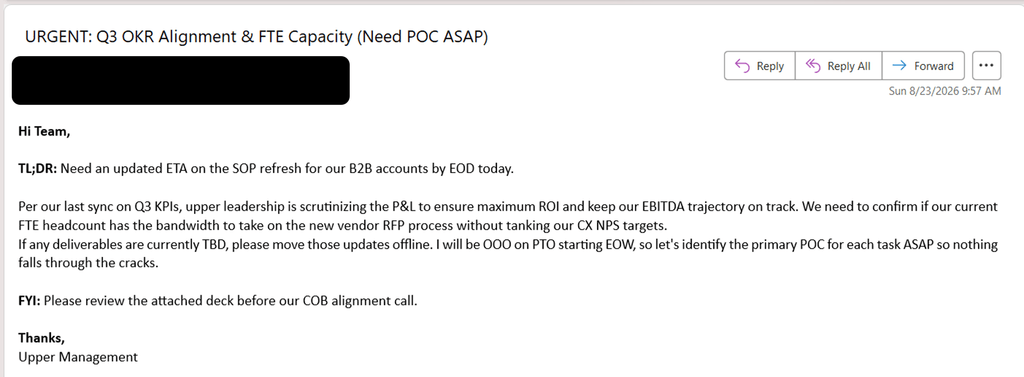
A while back, when I changed companies, I moved from a less jargony one to a place that uses acronyms very often. I remember the very first email I got after landing that role because it said something along the lines of “I need this report by EOB.” I was very familiar with EOD (End of Day), but I had never heard of EOB. My mind was full of questions and potential scenarios: Should I ask what EOB means? If I do, will they think I’m stupid? Should I just pretend I get it, but then risk missing the deadline? It was a mess. Eventually, I just asked: “Look, I don’t know what EOB means, and I don’t want to mess anything up.”
Unfortunately, the corporate world is a jungle of jargon and strange language that almost everyone uses, but not everyone understands. For a first-time manager, all of these can be very confusing and, to be fair, very strange. If you are a struggling adventurer who just landed in this jungle, this article will help you navigate it. Here are the main topics we will cover today:
- Your Everyday Communication and Scheduling
- Core Strategy and Performance Metrics
- Financial Basics
- Operations and Team Management
Your Everyday Communication and Scheduling
It’s no big secret that most of the time, corporate emails and other forms of communication – especially in writing – feel like decoding a secret service language. When it comes to everyday communication and scheduling, we see a lot of these acronyms, so let’s take a quick deep dive and see what they are all about.
FYA, ASAP, and ETA
One of the core principles behind this “new-age code” is actually very practical: keep your emails short so you don’t overwhelm your team. In a way, it’s about letting people know what they need to do using a shorthand code that conveys the exact message.
- FYA or FYI – For Your Attention or For Your Information is the one we read most often. An estimated 90% of workplace communications use some version of this. It is used to pinpoint text that needs to be fully understood or brought to your attention – usually for procedure changes, updates, or things you need to catch up on.
- ASAP – As Soon As Possible is something you see, hear, and probably use all the time. While not specifically made for corporate environments, it is used very frequently here (around 85% frequency). It’s used when someone needs something urgently, or when a specific activity or task must be prioritized and done as quickly as possible.
- ETA – Estimated Time of Arrival is very common in project management activities when you need to know when something will arrive or be completed. Most of you are probably familiar with this concept from movies, as ETA is used quite a lot in military or law enforcement scenarios. With a high frequency of usage (around 75%), ETA is something you will hear a lot.
OOO, PTO, and TBD
Moving on to calendars, schedules, and coverage, we have three famous acronyms people use at their desks. Their primary role is to highlight time-related elements so people can plan accordingly.
- OOO – Out of Office is the one we see all the time in automatic email replies. People usually leave this type of reply when taking time off to let others know, “Hey, I am not working today, so please take that into consideration.”
- PTO – Personal Time Off (or Paid Time Off) is a terms-based variation of OOO. Some people prefer this one over the other; from my experience, people often use PTO in casual conversation when signaling that a vacation is approaching, whereas OOO is used more in auto-replies.
- TBD – To Be Determined is a way of saying that the deadline or detail for a task or activity is yet to be established. It is used when something isn’t finalized to let people know that additional information will follow.
TL;DR and EOD / EOB / EOW
These are the acronyms you will usually use or see when people need to communicate with very busy colleagues. (Aren’t we all busy, though?) In any case, they have distinct functions: one provides an overview, while the other three signal fixed points in time.
- TL;DR – Too Long; Didn’t Read is used to introduce a quick overview or summary of a specific situation. (I personally use “Overview” or “Summary,” as I find this exact acronym slightly less formal, and older generations may not be as familiar with it.)
- EOD / EOB / EOW – End of Day, End of Business (day), or End of Week are set points in time used to signal when something is due or will be completed.
Core Strategy and Performance Metrics
This is where we find specific jargon related to strategy and performance metrics. These represent core business terminology and are used very frequently.
KPI and OKR
By now, everyone has heard these or seen them in an email, so let’s clarify what each one means:
- KPI – Key Performance Indicator is all about performance. A KPI is a target value that you and your team must reach. It is a select, highly strategic metric chosen by the business to measure progress toward an objective, answering the question: Are we achieving our goal? More info on this topic is available in this article: I’m Not Good with Data: The Non-Analytical Lead’s Guide.
- OKR – Objectives and Key Results is a goal-setting framework used by companies to align teams around ambitious, measurable outcomes. Popularized by Intel and Google, it bridges the gap between high-level company strategy and daily execution. An OKR has two distinct components:
- Objective (The “Where do we want to go?”): A qualitative, inspiring, and memorable goal that sets the direction without needing numbers.
- Key Results (The “How do we know we’re getting there?”): A set of 3–5 quantitative, measurable metrics that track progress toward the objective.
ROI and NPS
These two cover completely different aspects of business strategy and performance: one measures what you get in return for an investment, while the other measures customer satisfaction.
- ROI – Return on Investment explains to stakeholders, upper management, or clients that if you invest a certain amount of time, resources, or money into a specific activity or tool, you will receive specific benefits. For example, consider making bread by hand versus using a machine: buying the machine is the investment, and the return is an increase in production and sales due to automation.
- NPS – Net Promoter Score is a standardized metric used across industries to measure customer loyalty, satisfaction, and overall brand perception. Developed in 2003 by Bain & Company, it hinges on a single fundamental question: On a scale of 0 to 10, how likely are you to recommend our company/product/service to a friend or colleague? The respondents are grouped as follows:
- Promoters (Score 9–10): Loyal enthusiasts who keep buying and refer others.
- Passives (Score 7–8): Satisfied but unenthusiastic customers who are vulnerable to competitive offers.
- Detractors (Score 0–6): Unhappy customers who can damage your brand through negative word-of-mouth.
- Calculation: NPS = % Promoters − % Detractors (expressed as a number between -100 and +100).
B2B and B2C
These acronyms describe the type of customers your company serves. They are fast, clear indicators of your business model.
- B2B – Business to Business means selling products or services directly to other companies (e.g., Salesforce, corporate consulting, wholesale manufacturing). Sales cycles are longer, contract values are higher, and buying decisions involve multiple stakeholders.
- B2C – Business to Consumer means selling products or services directly to individual consumers (e.g., Netflix, retail clothing, local restaurants). Sales cycles are shorter, purchase volumes are higher, and messaging targets personal needs and emotions.
Financial Basics
Depending on how high up you are on the corporate ladder, there are two major financial acronyms you will hear and use most of the time. They measure business success, but at different levels.
P&L – Profit and Loss
The P&L statement (also called an Income Statement) is a financial report that summarizes a company’s revenue, costs, and expenses over a specific period (monthly, quarterly, or annually).
- The Core Equation: Revenue (Top Line) − Expenses = Net Income (Bottom Line)
- What it shows: The full picture of whether a team, department, or company is making or losing money after all costs are accounted for.
- Why it matters to managers: Your team’s budget, tools, headcount, and operational expenses live directly on the expense side of a P&L.
EBITDA
EBITDA stands for Earnings Before Interest, Taxes, Depreciation, and Amortization. It is a metric used to evaluate a company’s core operational performance without accounting rules or financial structures distorting the numbers.
- The Components: Net Income + Interest + Taxes + Depreciation + Amortization
- Interest: Depends on how much debt the company chose to take on (a financing decision).
- Taxes: Depends on local government regulations and geography, not daily operations.
- Depreciation & Amortization: Non-cash accounting entries that write off past physical assets (like machinery) or intangible assets (like patents) over time.
- What it shows: How effectively a company generates profit purely through its day-to-day core operations.
Operations and Team Management
When dealing with daily operations and team management, a few acronyms are particularly common. They relate to points of contact or specific operational stages.
POC and FTE
- POC – Point of Contact is used when people need to know who is directly responsible for a task, project, or topic.
- FTE – Full-Time Employee is used by managers, project leads, stakeholders, and workforce planning to describe staffing levels. At a certain management level, headcount is tracked using FTE or PTE (Part-Time Employee). This distinction is necessary because each category involves different cost structures, objectives, hours worked, and output volumes.
SOP and RFP
By now, you have likely encountered at least one of these concepts – especially an SOP. Here is a quick breakdown of both:
SOP – Standard Operating Procedure
An SOP is a set of step-by-step written instructions that documents how to execute a routine or critical operational process.
- Purpose: To ensure consistency, output quality, regulatory compliance, and efficiency across a team.
- Why it matters to managers:
- Onboarding: Reduces training time for new hires by giving them a clear guide.
- Error Reduction: Prevents knowledge loss when key team members leave or take time off.
- Scale: Allows operations to expand without a drop in quality.
RFP – Request for Proposal
An RFP is a formal document issued by an organization when soliciting bids from external vendors, contractors, or service providers for a specific project.
- Purpose: To outline project requirements, scope of work, budget parameters, and evaluation criteria so vendors can submit competitive proposals.
- Why it matters to managers:
- Fair Evaluation: Ensures you evaluate potential vendors using identical criteria rather than gut feel.
- Cost Control: Encourages competitive pricing among vendors to secure the best ROI.
- Risk Mitigation: Forces both your company and the vendor to clarify expectations before signing a contract.
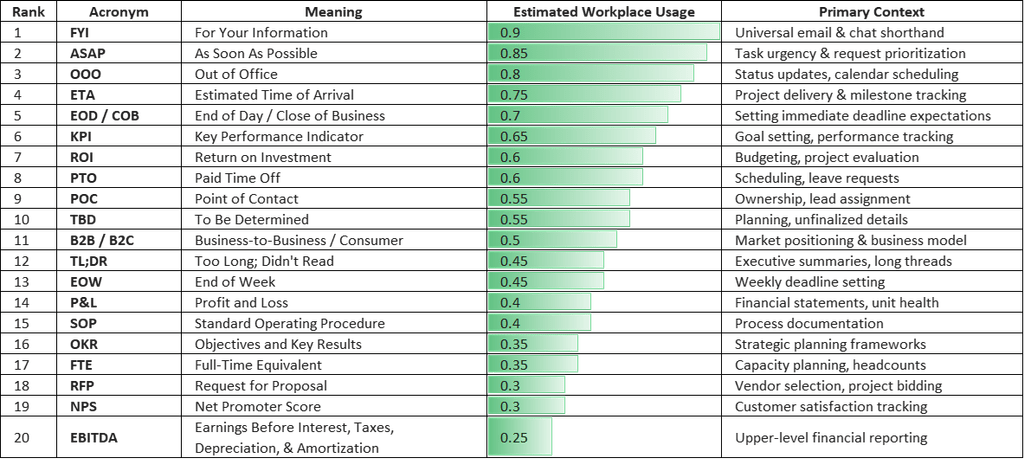
Before we end the article, I just want to leave this here: a short summary of the 20 most used acronyms, their meanings, when they are used, and their typical frequency of usage.
Until the next article, stay healthy, happy, and safe!