
How can I create a simple process map without being an expert?

Ever had to explain to other people what your process looks like?
Isn’t it strange when we sit down with another person and look at their face while they try to understand what we are even talking about? One of the more difficult aspects for a new leader is how to make things that are complicated seem less complex. And it’s not something everyone can do just like that. In reality, people (in general) are not really good at trying to explain what they do or describing something the other person has no knowledge about.
I struggled with this for many years across my working experience because I was always trying to make people understand my exact and very specific perspective on the situation. So, if you are like I was, this is the article you need right now. In it, we will go over the following aspects:
- Why process mapping usually gives new managers a headache
- What SIPOC actually stands for
- How to build your map in 15 minutes
- Setting clear boundaries
- Benefits of using SIPOC
Process mapping and the headache
What is process mapping anyway?
To put it simply, it’s a way of translating your entire process into a very simple schematic, one that is made step-by-step. Let’s put it into an example: you are an expert bread maker and you want to train other people how to make these perfect breads. You need to map your process, and to do that, you start by writing down every little step you take. Then you just put them in a schematic. Something that should look like this:
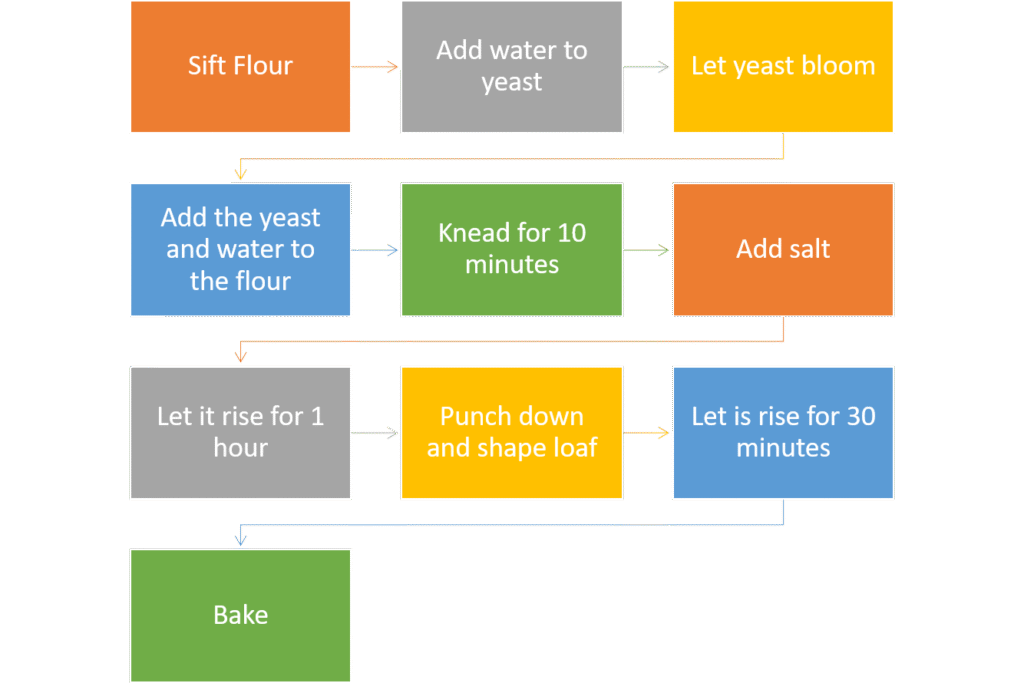
Sometimes managers tend to disregard process mapping. This is not the smart move, because documenting what you and your team do is the cornerstone of improvement. When you need to check something, you look at the process map. When you have a new person on the team, a process map can help provide the overview. If you need to explain the process to your boss or customer, you have the map handy. But why do managers get a headache when they hear about process mapping?
Well, the first aspect here is the workflow. There are no simple, non-complicated processes (at least not in my 20 years of experience). All companies have them, and most of the time they are a messy web of chaotic steps. So, make your life a bit easier: start working on and documenting each process in your team. Trust me, it will come in handy much more often than you think.
Another aspect is the micro-details that people sometimes get caught up in. When nothing is documented, you tend to spend more time trying to over-analyze and check very minuscule things instead of the big picture. This is why having a map helps: it keeps you on track and will also help you identify whatever step you need to check.
Normally, process maps are done in a tool called Visio. A “by the book” process map is a bit more complex than the SmartArt I used above. This, however, doesn’t have to be a stopper: meet the SIPOC, your 15-minute process map. SIPOC is a great visual way to document your process. It’s very simple to do and doesn’t require complicated tools or systems.
SIPOC
While the acronym is maybe strange for someone who has never used it before, the theory behind it is very simple: Supplier, Input, Process, Output, and Customer.
Let’s take a very basic example: baking an apple pie. How would a SIPOC look?
- Supplier: This is the place you go to buy the ingredients (your favorite store will do just fine).
- Input: This would be your ingredients, basically everything that goes into the pie (flour, butter, eggs, apples, cinnamon, sugar).
- Process: This will describe how you make the pie – step by step.
- Output: The pie.
- Customer: Whoever is eating or buying the pie.
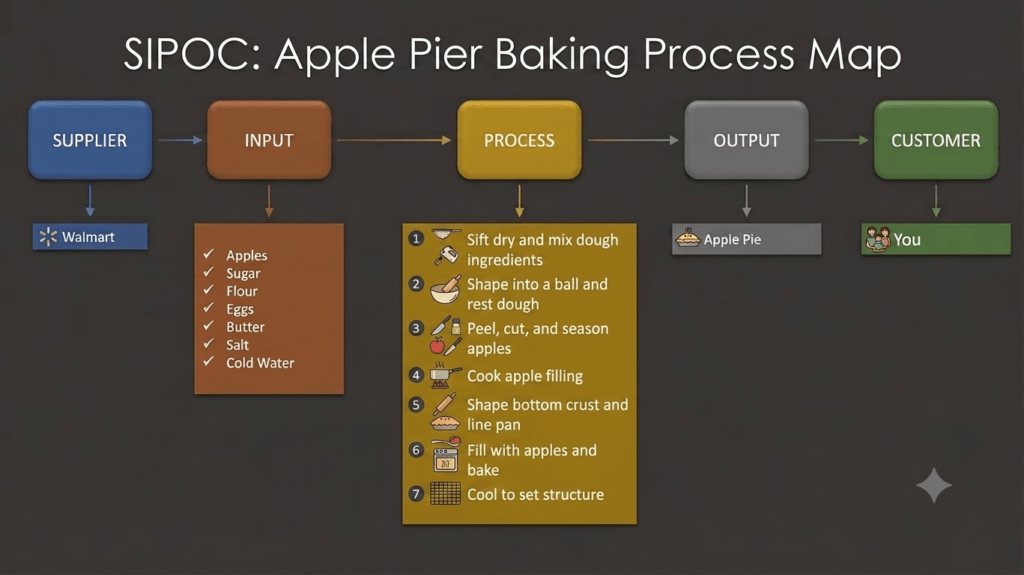
Here are some insights regarding each category:
- Suppliers: Who hands you the raw materials, requests, or information. Keep it short and simple; don’t overcomplicate it.
- Inputs: What stuff you actually need in hand before any real work starts. Only list what inputs are actually going into the specific process, nothing else.
- Process: The 4 to 7 big high-level steps that get the job done. Simple and to the point. Try to keep it to a maximum of 7 steps (if possible). The goal of SIPOC is to create an overview, not to be a detailed process map.
- Outputs: What tangible work your team finishes and sends out the door: just the outcome, nothing else.
- Customers: Who receives that finished product and what they expect from it.
How to Build a SIPOC
Since it is a simple overview, it should not take you more than 15–20 minutes. The trick is to make sure you have the right people on board. Many first-time managers have difficulties in letting go of the “Doer” (details in this article: The Shift from DOER to ENABLER).
The best people to help build a SIPOC are your process experts. If you are one, fine – just do it and make sure you train people in the future to become experts! But if you have experts in your team, ask them for help.
Your first step, ironically, is to start at the end: check your customer and output. For what product or service are you trying to make this map? It must be perfectly clear before you start. While it might appear to be counterproductive, going backwards on many occasions can be of more help than you might think, because it helps you separate the detailed from the general and sets the path for whatever you want to achieve.
Then start adding the process steps (maximum 7 if possible). The steps should be condensed as much as possible and made as simple as you can. Think about the SIPOC as trying to explain what you do at your job to your grandmother.
Then you add your Inputs and your Suppliers.
Setting Clear Boundaries
A big issue with these process maps is the inability of people to clearly separate things. On paper, it’s very easy to just say “do it like that,” but in reality, the desire to overcomplicate even the simplest of tasks is very powerful. To counter this, you need to define a clear Start and Stop for the process before you even begin working on it. This helps you identify the scope and keeps you on track (you know, in case you tend to overreach).
Another issue would be sub-processes linked to whatever process you are trying to map out. In this case, always go with “this is another SIPOC, so we leave it for another day.” Don’t get caught up in the chaos of overcomplicating everything. If you have Process A to map, stick just to Process A; and if you also have A.1 and A.2 linked to A, then do 2 more SIPOCs, one for each.
Benefits of using SIPOC
The most important one would be this bird’s-eye view of the process: having the overview can help you identify fast and easy what bottlenecks you have, where the process needs improvement, areas that can be replaced or removed, or just to re-check if whatever steps you are doing are currently relevant or needed. Many processes undergo changes (even from one month to another), and it’s important to review them often to make sure things don’t have too much waste (details about waste in this article: Spotting and Eliminating the 8 Types of Waste (DOWNTIME)).
Another benefit is having a comparison tool for your team. Share it with them and let them check if they are actually following the steps they should be. Maybe some of them have a defective way of doing a task, and this might help them get better. Some might even have an improvement suggestion (something they are doing that is faster and of better quality). This is why sharing is caring, right? It helps the team see how much you invest in them, provides a clear guideline, and also helps you generate better engagement.
SIPOCs can be used as a baseline for new projects, hand-offs, customer connects, upper-management business cases, and so on. They serve as a very simple yet powerful tool because it’s visual, simple, and easy to follow. It’s one thing to show someone a Standard Operating Procedure of 15 pages, and another thing altogether to show a simple picture with a few steps.
As a final thought on SIPOC, remember this: it is not some sacred document carved in stone and left by ancient gods; it’s just a quick diagnostic snapshot.
Until the next article, stay safe, stay healthy, and happy!